.avif)
The Impact of Rodent Damage on Your Attic Ductwork Efficiency
If your cooling system runs constantly but your home stays warm, roof rats may have chewed through your flex ducts. See why a tape patch isn't enough to safely restore your system's airflow.
If your cooling system runs constantly but your home stays warm, roof rats may have chewed through your flex ducts. See why a tape patch isn't enough to safely restore your system's airflow.

When Your Cooling System Runs Non-Stop But Your Home Stays Warm
Your AC is running nonstop, but the house still feels warm, leaving you to wonder if the impact of rodent damage on your attic ductwork efficiency is the real issue. You keep adjusting the thermostat down, hoping for a blast of cold air, yet the vents only push out a weak, lukewarm breeze. This is a common and incredibly frustrating scenario during the September and early fall pre-heating season. Lingering late-summer heat makes a struggling cooling system unbearable, and most homeowners immediately assume they are dealing with a severe refrigerant leak or a failing compressor.
To get to the bottom of this issue, our team at Jaguar Heating & Air has found that professional Air Conditioning diagnostics are the best first step.
Before you assume your outdoor unit is completely broken, you need to look upward. In our experience, the true culprit in many Sacramento homes with attic-run flex ducting is often hidden in the dark: torn, destroyed flex ducts caused by active roof rats. When you discover this kind of destruction, you face an immediate decision. Do you attempt a quick DIY tape patch to restore airflow, or do you hire a professional to replace the compromised ductwork entirely? Understanding exactly what is happening in your attic is the only way to make the right choice for your home's comfort and safety.
Common Symptoms of Hidden Ductwork Damage
It is easy to confuse mechanical failure with massive airflow loss. If rodents have chewed through your flex ducts, our technicians typically notice a specific pattern of symptoms in your living space:
• Weak airflow from specific vents: One room might feel perfectly fine, while the adjacent bedroom gets almost no air.
• Unusual dust accumulation: You might notice a sudden increase in dust or fiberglass particles settling on your furniture.
• Strange odors when the system runs: A musty, dirty, or distinctly unpleasant smell often accompanies the air coming out of the vents.
• The system never cycles off: The thermostat registers that the room is too warm, forcing the equipment to run continuously without ever reaching the set temperature.
Addressing these signs early can save your system from severe mechanical strain and keep your energy bills from spiraling out of control.
The September Shift: Why Roof Rats Target Your Attic Ductwork
The problem: Right as the season begins to transition, your cooling system suddenly stops keeping up with the afternoon heat. You check the filter, you check the breaker, but everything seems normal.
The cause: The specific climate dynamics of the region create a perfect storm for pest intrusion. In our years serving Sacramento, we've seen how September brings a unique weather pattern: lingering daytime heat waves that require heavy AC usage, combined with suddenly dropping overnight temperatures. As the nights get colder, roof rats seek out warm, insulated shelter to build their nests. Your attic provides the ideal refuge. Flexible ducting is made of a thin inner liner, a thick layer of fiberglass insulation, and an outer vapor barrier. To a roof rat, this soft, easily chewed material is the perfect resource for nesting.
The solution: Recognizing this seasonal pattern helps you understand why your system suddenly failed. The AC is still running heavily during the hot day, while rodents actively destroy the ducts at night.
The Perfect Storm in Your Attic
During the September and early fall pre-heating season, this combination of heavy daytime cooling and overnight rodent activity creates massive efficiency drops. The rats chew through the outer jacket of the flex duct to harvest the fiberglass insulation. Once they breach the thin inner liner, the conditioned air meant for your living room blasts directly into the attic space.
Because the damage happens out of sight, we often see homeowners let the system run for days or weeks, assuming the unit just needs a tune-up. Meanwhile, the rodents continue to expand their nests, tearing larger holes in the ductwork and causing an escalating loss of airflow.
Diagnosing the Drop in Efficiency: Equipment Failure vs. Airflow Loss
Standard HVAC diagnostics might miss the root cause entirely if a technician only checks the outdoor compressor or the indoor air handler. If the mechanical components are functioning perfectly, a basic electrical check will show that the system is operating as designed. However, the air is simply never reaching your living space.
This is where comprehensive whole-system inspections make all the difference. At Jaguar Heating & Air, our thorough diagnostics go beyond basic equipment checks to uncover the hidden attic and ductwork issues that actually cause sudden energy spikes. Our technicians evaluate the entire airflow path, ensuring that the air your system produces actually makes it into your home.
For example, our team recently helped a Sacramento homeowner who reached out during a 95-degree summer heatwave when their AC was suddenly blowing ambient, weak air. A technician arrived, inspected the mechanical unit, and found it was operating perfectly. The real issue was discovered during the attic inspection: the ductwork was severely compromised. Once the damaged ductwork was professionally replaced, the system was back to working flawlessly. This is why proper AC Repair must always include a thorough evaluation of the duct system.
Why Whole-System Inspections Matter
When you live in Sacramento homes with attic-run flex ducting, you cannot separate the performance of the equipment from the condition of the ducts.
• Mechanical failure symptoms: Warm air blowing from all vents, strange grinding noises from the outdoor unit, or a system that trips the circuit breaker immediately.
• Airflow loss symptoms: The unit sounds completely normal, the blower is running, but little to no air exits the registers, and the house remains uncomfortably warm.
Without a comprehensive inspection, you might end up paying for unnecessary mechanical repairs while the true problem continues to tear apart your attic.
The Hidden Cost of Cooling Your Attic Space
The energy waste caused by compromised ductwork is staggering. When rodents tear open your flex ducts, they effectively turn your uninsulated attic into the only cooled space in your house.
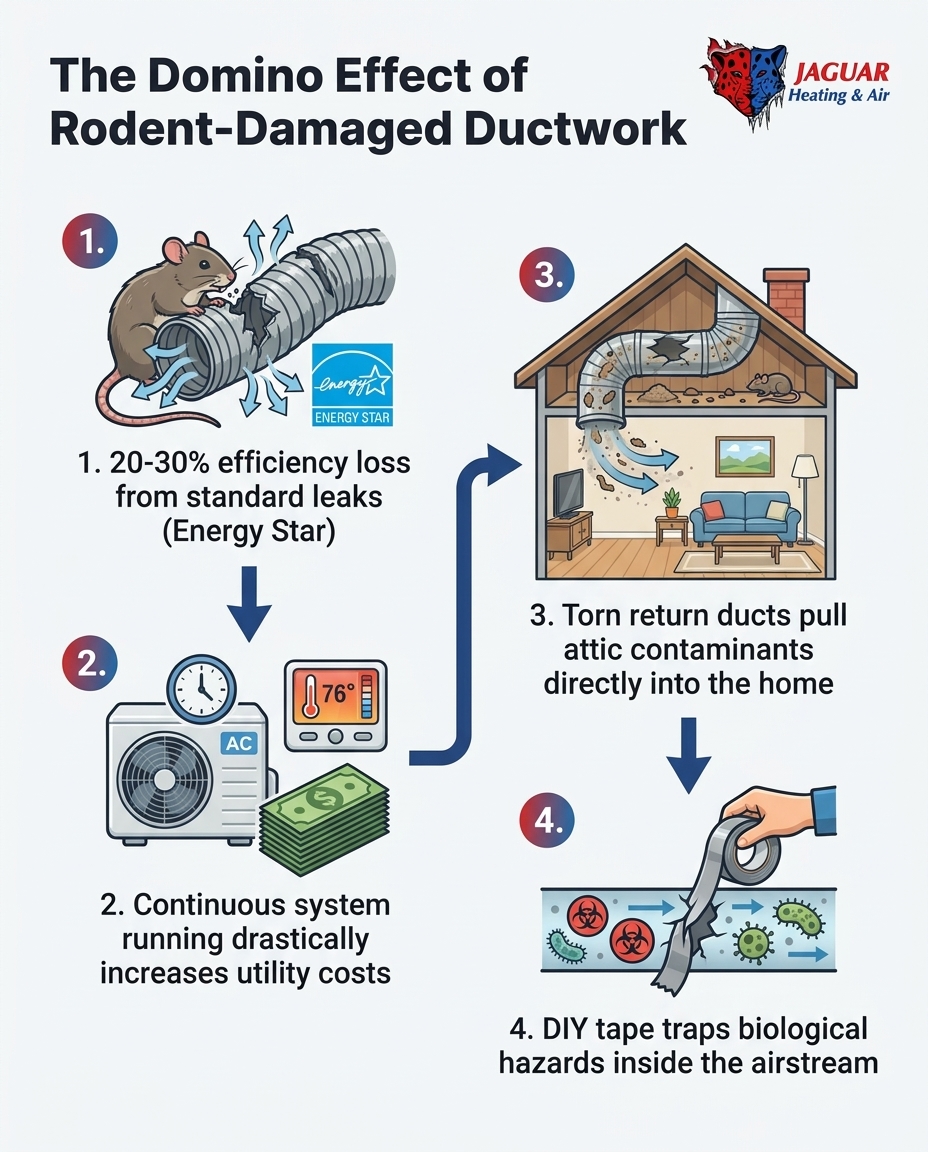
1. Massive Efficiency Loss: According to EPA and Energy Star data, even standard, minor leaky ducts reduce cooling efficiency by 20 to 30 percent. When you introduce massive tears from rodents, that energy loss becomes catastrophic. You are paying to air-condition the underside of your roof.
2. Severe Component Strain: Because the thermostat in your hallway never registers the target temperature, it commands the system to run continuously. This non-stop operation places immense wear and tear on the system's components. The compressor overheats, and the blower motor works overtime. If your AC blower motor sounds like a jet engine, it is likely struggling against severe static pressure imbalances caused by torn ducts.
3. Sudden Utility Spikes: This continuous running translates directly to your monthly utility bills. Homeowners often notice a massive, unexplained spike in their energy costs just as the weather begins to transition.
4. Premature System Failure: HVAC systems are designed to cycle on and off. Forcing them to run 24/7 to compensate for lost air drastically shortens the lifespan of the equipment, turning a ductwork problem into a full system replacement if left unchecked. Should a replacement become necessary, federal tax credits or utility incentive programs may apply to qualifying high-efficiency installations, but we always advise verifying current programs with your utility provider or a tax professional.
Comparing Ductwork Damage Impacts
• Standard Wear and Tear (Pinholes) — Airflow Loss Expected: 20% to 30% loss — Impact on System & Home: Longer cooling cycles, gradual energy waste, mild dust.
• Disconnected Joints — Airflow Loss Expected: 40% to 50% loss — Impact on System & Home: Specific rooms feel entirely unconditioned, moderate utility spikes.
• Massive Rodent Breaches — Airflow Loss Expected: Up to 80% loss in affected zones — Impact on System & Home: System runs non-stop, catastrophic energy waste, severe IAQ hazards.
Beyond Efficiency: The Severe Indoor Air Quality Hazards
While the sudden spike in energy bills is usually what catches a homeowner's attention, the health and safety risks of compromised ductwork are far more serious. When roof rats destroy your flex ducts, they do more than just let cold air out—they let dangerous contaminants in.
Your HVAC system operates using supply and return ducts. If a return duct is torn, the system acts like a giant vacuum, pulling the stagnant, dirty air from your attic directly into the home's airstream. This bypasses your air filter entirely. In our experience working on Sacramento homes with attic-run flex ducting, this means your family is breathing whatever is floating around in the attic space.
The biological contaminants introduced by rodents are highly hazardous. Rats leave behind droppings, urine, and nesting debris directly inside the torn ductwork. When the blower motor turns on, these particles are swept up and distributed through every vent in your house. According to CDC guidelines, rodent-borne diseases and allergens pose serious health risks when introduced into residential air supplies. Protecting your Indoor Air Quality requires immediate action once a breach is discovered. Once pests compromise the ductwork, the entire home's air supply is potentially contaminated until professional remediation takes place.
The Hidden Dangers in the Airstream
Breathing in attic air means exposure to a variety of irritants:
• Microscopic fiberglass particles: Insulation fibers torn loose by rodents are easily carried into the living space, causing respiratory irritation.
• Allergens and pathogens: Dried rodent waste breaks down into fine dust that triggers severe allergic reactions and asthma attacks.
• Stagnant heat and dust: Unconditioned attic air is filled with years of settled dust, pollen, and outdoor pollutants that defeat your home's filtration system.
Why DIY Tape Patches Fail on Contaminated Flex Duct
The problem: When you climb into the attic and see a massive hole in your flex duct, the immediate temptation is to grab a roll of duct tape, wrap the hole, and quickly restore airflow to the house.
The cause: Standard tape simply cannot properly seal flexible ducting. Flex ducts consist of a coiled wire inner liner, a thick layer of fiberglass, and an outer vapor barrier. Tape cannot bind these distinct layers back together. Furthermore, the massive temperature swings in a September / early fall pre-heating season attic will cause the adhesive on standard tape to dry out, crack, and fail within weeks.
The solution: More importantly, taping over a breach is physically dangerous to your home's air quality. When you wrap tape over a chewed hole, you are trapping biological contaminants—urine, droppings, and nesting materials—permanently inside the ductwork. Every time the system runs, air passes over this trapped waste, continuing to degrade your indoor air quality. Handling contaminated insulation and torn ducts requires professional remediation and complete replacement. You should never attempt DIY step-by-step repairs on compromised flex duct.
The Structural Reality of Flex Duct
Flex duct relies on airtight integrity to maintain static pressure. Even if a tape patch holds temporarily, the structural shape of the duct is usually crushed or distorted by the rodents sitting on it. This distortion restricts airflow just as badly as a tear. Professional replacement ensures the proper diameter, tension, and structural integrity are fully restored.
Professional Solutions for Restoring Your System's Performance
Resolving rodent-damaged ductwork requires a strict, professional approach to guarantee both restored efficiency and a safe breathing environment. When our technicians at Jaguar Heating & Air address this issue in Sacramento homes with attic-run flex ducting, we follow a comprehensive process that prioritizes your home's safety.
First, the compromised sections of the flex duct are carefully contained and professionally removed. Complete replacement of the affected section is the only way to guarantee restored efficiency and eliminate the severe IAQ hazards left behind by pests. Technicians do not simply patch the holes; we cut out the entire contaminated length and install brand-new, fully sealed flex ducting.
Next, it is crucial to inspect the remaining intact ductwork to ensure no secondary breaches exist. Rodents rarely stop at just one spot, and finding every point of entry is vital for system performance. Finally, professional Duct Cleaning of the remaining intact system may be recommended after the damaged sections are completely replaced. This ensures that any residual dust, fiberglass, or microscopic contaminants that migrated into the main trunk lines are safely extracted.
What the Professional Process Looks Like
• Thorough Inspection: Mapping the entire duct system to identify every compromised section.
• Safe Containment: Bagging and removing the contaminated ductwork without spreading debris into the home.
• New Installation: Sizing and installing new flex duct with proper tension and mastic sealing.
• System Testing: Measuring airflow and static pressure to confirm the system is perfectly balanced and operating at peak efficiency.
Protecting Your Home's Comfort Before Winter Arrives
Sudden efficiency loss and a system that runs non-stop are often ductwork issues rather than catastrophic equipment failures. If you are struggling to keep your home comfortable during the September / early fall pre-heating season, addressing torn ducts professionally is the only way to protect both your energy bills and your indoor air quality. Schedule your comprehensive system tune-up with Jaguar Heating & Air before the winter weather hits to ensure your home is heating safely, efficiently, and cleanly all season long.
Frequently Asked Questions
Can rats chew through HVAC flex ducts?
Yes, rats can easily chew through flexible HVAC ducts. Flex ducting is made of a thin inner plastic liner, a layer of soft fiberglass insulation, and a foil or plastic outer jacket. Rodents find these materials incredibly easy to tear apart, and they frequently harvest the fiberglass to build warm nests in the attic. Once they chew through the outer layers, they quickly breach the inner liner, causing massive airflow loss.
Why is my AC running constantly but the house is warm?
When your AC runs non-stop but fails to cool the house, it usually means the conditioned air is escaping before it reaches your vents. While this can sometimes point to a refrigerant leak, it is very often caused by massive tears in your attic ductwork. The system is effectively cooling the attic space, forcing the thermostat to keep the equipment running continuously to try and reach the set temperature.
How do you fix ductwork chewed by rodents?
Ductwork chewed by rodents must be completely removed and replaced by a professional. You cannot simply patch or tape over the holes, as this traps dangerous biological waste inside the airstream and fails to restore the structural integrity of the duct. A licensed technician will cut out the entire contaminated section, install new flex duct, and properly seal all connections with mastic.
What happens if mice get into your air vents?
If mice get into your air vents, they introduce severe biological contaminants directly into your home's breathing air. They leave behind droppings, urine, and nesting debris that break down into microscopic particles. When the blower motor turns on, these allergens and potential pathogens are circulated through every room in the house, drastically lowering your indoor air quality.
Is it safe to tape a duct chewed by mice?
No, it is never safe to tape a duct that has been chewed by mice. Taping over a rodent breach traps their urine and droppings inside the ductwork, meaning air will constantly pass over this biological waste before entering your living space. Additionally, standard duct tape cannot withstand attic temperature swings and will quickly dry out, peel off, and fail.
How much efficiency is lost when attic ducts are torn?
Standard minor leaks in ductwork can reduce system efficiency by 20 to 30 percent, but massive tears from rodents can cause near-total airflow loss in affected zones. When a flex duct is completely severed or heavily chewed, up to 80 percent of the conditioned air for that specific room is lost into the attic. This results in catastrophic energy waste and significant spikes in your monthly utility bills.
Recent Posts

How Proper Refrigerant Charge Impacts Your Monthly SMUD Bill
Blaming lingering Sacramento heat for high September electricity usage? A minor 10% refrigerant undercharge forces your AC to run drastically longer, quietly multiplying your energy costs.
Why Your AC Vents Are Dripping Condensation Onto the Floor
Water pooling under your ceiling registers is a stressful surprise. Understand the physics behind sweating duct boots and know when to call a professional before drywall damage occurs.
The Financial Math of Repairing vs. Replacing a Failed Compressor
A dead compressor on an aging AC system forces a tough choice. We break down the percentage-based lifespan math so you can confidently decide between a heavy repair and a full replacement.