.avif)
How Proper Refrigerant Charge Impacts Your Monthly SMUD Bill
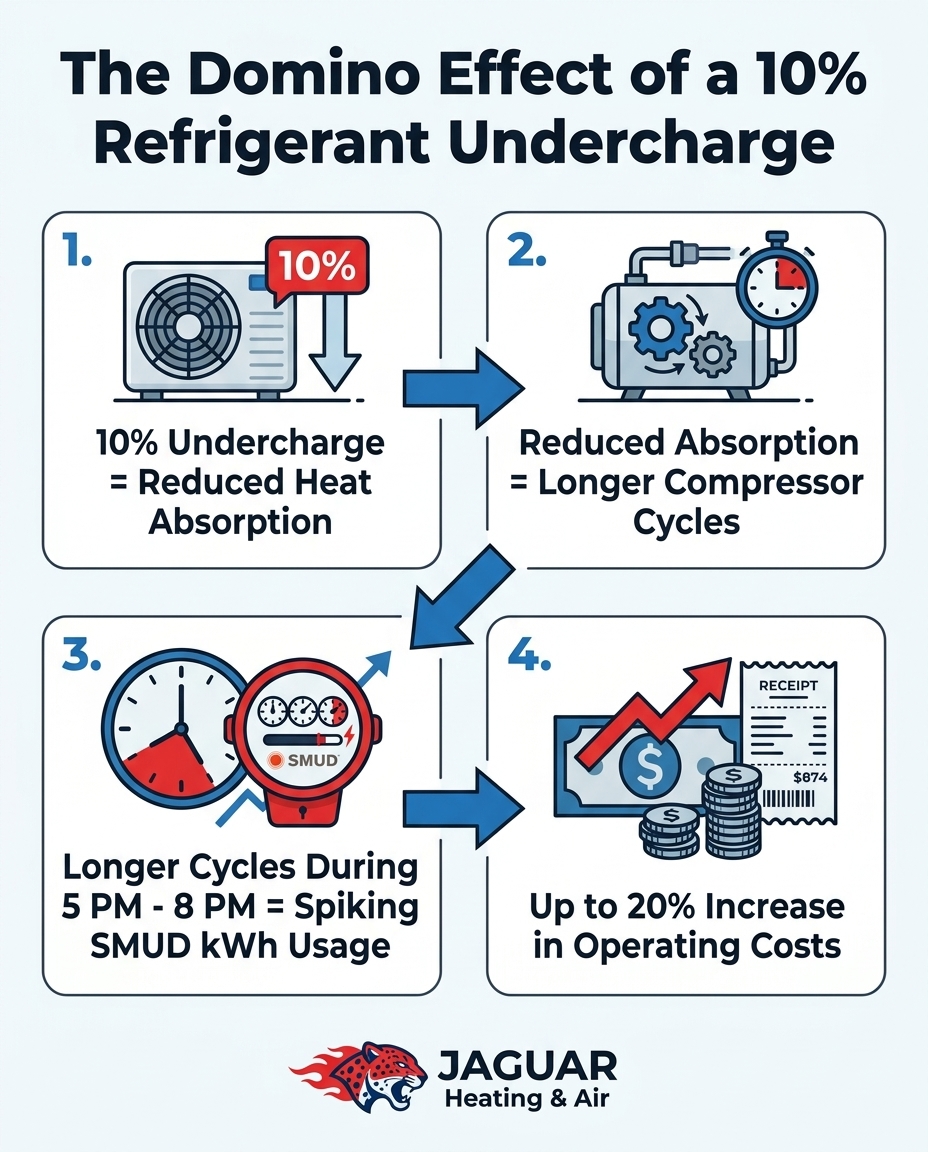
Blaming lingering Sacramento heat for high September electricity usage? A minor 10% refrigerant undercharge forces your AC to run drastically longer, quietly multiplying your energy costs.
Blaming lingering Sacramento heat for high September electricity usage? A minor 10% refrigerant undercharge forces your AC to run drastically longer, quietly multiplying your energy costs.

The Hidden Cause Behind Spiking Late-Summer Energy Usage
A refrigerant undercharge of just 10 percent can increase your system's operating costs by up to 20 percent, which perfectly illustrates exactly how proper refrigerant charge impacts your monthly SMUD bill. As the summer winds down, many Sacramento homeowners open their utility statements expecting to see a drop in energy usage, only to be met with shockingly high numbers. In our years serving the Sacramento valley at Jaguar Heating & Air, we hear this frustration constantly. It is incredibly frustrating to feel like you are doing everything right—keeping the thermostat steady, closing the blinds, and changing the filter—yet still watching your electricity consumption climb. Most people simply blame the lingering heat, assuming their air conditioner is just working hard to keep up with the weather. However, the reality our technicians uncover in the field is often mechanical rather than environmental.
If you are tired of unexplained energy spikes, it is time to look beyond the thermostat and evaluate your system's core efficiency. Learn more about our comprehensive Air Conditioning Services and how scheduling professional Sacramento AC Maintenance can stop the waste before the season ends.
The underlying issue: When your system is operating while 10% undercharged, it loses a massive portion of its cooling capacity. This forces the equipment to run continuously just to maintain a basic level of comfort. You are left with a critical decision point: you can accept this high late-summer usage as a normal part of living in the valley, or you can have a professional evaluate the system's charge to uncover the hidden inefficiencies draining your power.
Why Lingering Sacramento Heat Exposes Mechanical Inefficiencies
During the September transition / late summer period, cooling degree days theoretically begin to drop. The nights start getting a little cooler, and the intense, relentless heat of July and August starts to break. Logically, your energy usage should decrease alongside the ambient temperature. However, Sacramento's extreme triple-digit summer heat puts immense wear and tear on residential HVAC systems. Months of continuous, heavy operation often lead to microscopic stress fractures in coils or degraded seals, allowing tiny amounts of refrigerant to escape unnoticed.
A pattern our Jaguar Heating & Air technicians see often during this seasonal transition involves systems that barely survived August and suddenly fail to cool the house in September. Just recently, a local homeowner reached out to our team during a stretch of lingering late-summer heat when their house simply was not cooling effectively anymore. Our technician arrived promptly, clearly explained the mechanical problem causing the system to struggle, and walked through the available options. By addressing the root cause rather than just the symptom, we got the house cooling effectively again without unnecessary delays. This type of heavy summer wear is exactly what leads to hidden mechanical failures.
If your kWh usage remains at peak-summer levels during the early fall transition, a mechanical issue is highly probable. The lingering September heat in our region is just warm enough to keep your system running, but not so extreme that it should be pulling maximum power continuously. This environmental heat load exposes the system's internal lack of cooling capacity.
The Illusion of Weather-Driven Energy Bills
It is incredibly common for homeowners to assume their AC is just working hard against the afternoon sun. We often falsely blame the weather for high usage rather than recognizing a mechanical leak caused by heavy summer wear.
• Normal heavy usage: The system cycles on, runs for 15 to 20 minutes to overcome the heat, reaches the set temperature, and cycles off.
• Inefficient over-usage: The system turns on and never shuts off, running for hours at a time because it lacks the capacity to actually remove the heat from your home.
• The tracking metric: By monitoring your daily kWh trends rather than just reacting to the ambient temperature outside, you can spot the exact moment your system stops operating efficiently and starts wasting electricity.
The Mechanical Math: What Happens When Your AC is 10% Undercharged
To understand why your energy usage spikes, you have to look at the mechanical reality of how an air conditioner functions. Your AC does not actually "create" cold air; it removes heat from the inside of your home and transfers it outside. Refrigerant is the chemical compound responsible for absorbing that heat. When your system is 10% undercharged, there is simply less chemical available to do the heavy lifting.
The problem: Refrigerant travels through your indoor evaporator coil, absorbing heat from the warm air blowing across it. When the volume of refrigerant is low, the coil is starved. It cannot absorb as much heat per minute as it was designed to handle.
The cause: A 10% reduction in refrigerant volume lowers the system's overall cooling capacity. The air blowing out of your vents might still feel relatively cool to the touch, but it is not cold enough to lower the temperature of the entire house efficiently.
The solution: The system must be accurately diagnosed, the leak repaired, and the exact volume of refrigerant restored so the evaporator coil can operate at full heat-absorption capacity.
Reduced Heat Absorption per Cycle
Refrigerant is the absolute lifeblood of the AC system. A 10% drop means 10% less heat removed during each cycle. Because the system is removing less heat, the thermostat registers that the home is still warm, forcing the equipment to keep running.
• 100% Optimal Charge — Heat Absorption: Maximum capacity — Cycle Length: 15 - 20 minutes — Energy Impact: Normal, expected kWh usage
• 10% Undercharged — Heat Absorption: Significantly reduced — Cycle Length: 45+ minutes to continuous — Energy Impact: Severe spike in kWh consumption
This prolonged cycle time is the silent driver of your high utility statements. The system is working twice as long to achieve a fraction of the result.
How Longer Compressor Cycles Multiply Your kWh Consumption
The compressor is the heart of your HVAC system, and it is also the largest consumer of electricity in your entire home. It requires a massive amount of power to compress the low-pressure refrigerant gas into a high-pressure liquid so it can release heat outdoors. When your system is properly charged, the compressor runs in short, efficient bursts. When the system is 10% undercharged, the compressor is forced into continuous, grueling operation.
This continuous operation becomes especially punishing when you factor in SMUD Time-of-Day (TOD) rates. Utility providers structure their rates based on grid demand. For SMUD customers, the peak hours hit between 5 PM and 8 PM. This is exactly when the lingering late-summer heat is still warming your house, and exactly when an inefficient, undercharged air conditioner will struggle the most.
An AC unit struggling to cool during these specific peak hours drastically multiplies your total kWh usage right when electricity is at a premium. You are not just using more power; you are using more power during the most demanding time of the day.
The Impact of Peak Utility Hours
Running an inefficient system during the late afternoon and early evening maximizes your energy waste.
• Continuous operation: A struggling compressor will not cycle off during the 5 PM to 8 PM window, meaning it draws heavy amperage non-stop.
• Grid alignment: This continuous draw aligns perfectly with peak utility demand, amplifying the impact on your monthly statement.
• Cycle optimization: Optimizing your system's cycle times by ensuring a proper refrigerant charge is critical for managing your overall electricity consumption.
Professional Diagnostics vs. the Deceptive 'Blind Top-Off'
When faced with an AC that is not cooling well, many homeowners look for a quick fix. Unfortunately, some technicians offer a deceptive "blind top-off"—simply adding a little bit of gas without ever checking to see where the original refrigerant went. Blindly adding refrigerant without finding the leak is a terrible financial strategy. Because an air conditioner is a completely sealed system, it should never lose refrigerant unless there is a physical hole or failing seal. If you have to add gas, you have a leak.
We see the consequences of this frequently. Just recently, a customer called our Jaguar Heating & Air team during a warm early fall evening because their AC was running low on Freon gas and clearly needed parts replaced. They needed next-day service. Instead of just temporarily topping off the system, our technicians arrived, performed comprehensive diagnostic tests, replaced the failing parts, and properly recharged the AC to exact specifications. The job was completed within the scheduled time, providing a permanent fix rather than a temporary band-aid.
At Jaguar Heating & Air, our precise diagnostic approach focuses on accurately weighing refrigerant to meet exact manufacturer specifications. Overcharging a system by blindly dumping gas into it can be just as damaging and inefficient as being 10% undercharged. We find the leak, fix the root cause, and restore the exact balance required to stop energy waste. You can learn more about why this matters by reading The Truth About 'Topping Off' Freon Every Summer.
Why Refrigerant Doesn't Just 'Evaporate'
It is a common myth that air conditioners "use up" refrigerant over time like a car uses gas. This is entirely false.
• Closed loop system: Refrigerant operates in a strictly closed loop, constantly cycling between a liquid and a gas state without ever leaving the copper lines.
• Indicators of damage: Low levels always indicate a leak that must be located and repaired by a professional using specialized detection equipment.
• The danger of top-offs: Topping off a leaking system is a temporary band-aid that guarantees future energy waste, as the gas will simply leak out again.
Addressing Refrigerant Leaks During the September Transition
The September transition / late summer period is actually the ideal time to address these lingering mechanical issues. Rather than waiting for your system to fail entirely during the next heat wave, being proactive now protects your equipment and your wallet. Many homeowners ignore the subtle signs of a leak because the weather is starting to cool down, assuming they can just deal with it next year. This is a mistake that compounds the damage to the compressor.
There are several hidden signs that your system is actively leaking refrigerant. You might notice ice forming on the indoor evaporator coils, which happens because the low pressure causes the remaining refrigerant to drop below freezing, turning ambient humidity into solid ice. You might also notice the air blowing out of your vents feels lukewarm rather than crisp and cold. If you observe any of these symptoms, it is time to schedule professional AC Repair in Sacramento to properly detect and seal the leak.
Addressing these leaks now offers long-term benefits. At Jaguar Heating & Air, we highly recommend pre-heating-season tune-ups because a properly charged system is essential not just for cooling, but also for those utilizing heat pumps for their upcoming winter heating needs. A system that is 10% undercharged in the summer will be equally inefficient when it reverses operation to heat your home in the winter.
Symptoms of a Struggling System
Keep a close eye on your system's behavior as the seasons change. Look for these distinct warning signs:
• Longer than normal cooling cycles: The system runs for 45 minutes or more without shutting off.
• Thermostat struggles: An absolute inability to reach the set temperature on the thermostat, even after hours of operation.
• Strange noises: Unusual hissing or bubbling sounds coming from the refrigerant lines near the outdoor unit.
• Elevated humidity: The home feels sticky and damp because the system is not running efficiently enough to dehumidify the air.
Preparing Your HVAC System for the Fall Transition
Resolving your air conditioning inefficiencies during the September transition / late summer window prevents compounded issues later in the year. When you allow an undercharged system to limp along, the compressor works so hard that it begins to overheat, degrading the internal lubricating oils and shortening the lifespan of the entire unit. By fixing the charge now, you bridge the gap between end-of-summer cooling repairs and overall, year-round home energy efficiency.
As the seasons change, it is highly valuable to evaluate your overall system performance. A pre-fall diagnostic is about more than just checking the refrigerant; it is about looking at the entire duct network, the blower motor amp draw, and the electrical connections. This comprehensive approach identifies other areas of waste that might be driving up your utility usage.
If you are serious about lowering your monthly consumption, consider exploring Energy Savings Audits. Proper, consistent maintenance protects the lifespan of your expensive equipment and optimizes your utility usage, ensuring that every kilowatt you pay for is actually working to keep your home comfortable.
Stop the Energy Waste: Schedule Your Pre-Fall Diagnostic
You do not have to accept high late-summer SMUD energy usage as an inevitable part of living in Sacramento. While the lingering heat certainly plays a role, a system that is struggling to keep up is often suffering from a mechanical deficiency like a 10% refrigerant undercharge. Continuing to run a compromised system will only multiply your kWh consumption and put your compressor at risk of premature failure.
There is a clear path forward. By scheduling a professional diagnostic, our Jaguar Heating & Air technicians can accurately measure your refrigerant levels, locate any hidden leaks, and restore your system to factory specifications. Stop the energy waste today. Reach out to our expert team to ensure your system is fully optimized, giving you the peace of mind that your home is running as efficiently as possible before the fall weather officially sets in.
Frequently Asked Questions
Does low refrigerant increase electricity usage?
Yes, low refrigerant significantly increases electricity usage by forcing the system to run longer. When the system lacks the proper chemical volume to absorb heat, the compressor must run continuously to try and reach the thermostat setting. This continuous operation drastically multiplies your daily kWh consumption.
Why is my AC running constantly in late summer?
Your AC runs constantly when it has lost the mechanical capacity to remove heat efficiently from your home. While extreme lingering heat is a factor, continuous operation usually points to a refrigerant leak, dirty coils, or a failing blower motor. A system that never cycles off is wasting massive amounts of power and requires professional diagnosis.
What happens if an AC is 10% undercharged?
If an AC is 10% undercharged, it loses a substantial portion of its heat-absorption capability, leading to a potential 20% increase in operating costs. The evaporator coil starves, preventing the system from cooling the air effectively. This forces the compressor to work harder and longer, accelerating wear and tear on the equipment.
Can a slight refrigerant leak cause a high SMUD bill?
Yes, even a minor leak will cause a high utility statement by keeping the system running during peak demand hours. Because the system takes much longer to cool the house, it often runs non-stop through the 5 PM to 8 PM peak utility window. This heavy, continuous draw maximizes your overall energy waste.
How do professionals accurately check AC refrigerant levels?
Professionals use specialized digital gauges and temperature sensors to measure the superheat and subcooling of the system. They calculate the exact pressures and temperatures against the manufacturer's specific design data. This highly precise mathematical approach ensures the system is charged to the exact ounce required for peak efficiency.
Why shouldn't I just have my Freon topped off every year?
Topping off Freon without fixing the leak is a temporary, wasteful band-aid that guarantees you will continue to lose efficiency. Air conditioners are sealed systems that should never consume or lose refrigerant under normal operation. If you need a top-off, you have a physical leak that must be located and permanently sealed to protect the compressor.
Recent Posts
Why Your AC Vents Are Dripping Condensation Onto the Floor
Water pooling under your ceiling registers is a stressful surprise. Understand the physics behind sweating duct boots and know when to call a professional before drywall damage occurs.
The Financial Math of Repairing vs. Replacing a Failed Compressor
A dead compressor on an aging AC system forces a tough choice. We break down the percentage-based lifespan math so you can confidently decide between a heavy repair and a full replacement.

How We Trace Elusive Refrigerant Leaks in Sacramento Attics
A slow summer leak can cause your AC to blow warm air when you need it most. We stop the cycle of endless top-offs by pinpointing the true root cause.