.avif)
The Truth About Chemical Coil Cleaners and Your AC's Longevity
While a sparkling clean condenser unit looks great, acidic sprays might be secretly destroying your equipment. See why we refuse to use them during fall tune-ups.
While a sparkling clean condenser unit looks great, acidic sprays might be secretly destroying your equipment. See why we refuse to use them during fall tune-ups.

The Myth of the 'Sparkling Clean' AC Unit
A bright, shiny metal surface might look like the ultimate sign of a well-maintained cooling system, but the truth about chemical coil cleaners and your AC's longevity is that achieving this instant shine often causes irreversible damage. Our team at Jaguar Heating & Air frequently meets homeowners who naturally assume that if their outdoor condenser unit looks brand new after a service visit, the system is perfectly clean and healthy. However, the reality of HVAC maintenance we see in the field is much more complex than surface-level aesthetics.
When you schedule Air Conditioning Services, you expect your equipment to be treated with care that extends its lifespan. Unfortunately, a common shortcut in the industry involves using harsh, highly acidic chemical cleaners to quickly dissolve dirt and grime. While these aggressive tactics produce an immediate, satisfying visual result, they do so by literally eating away at the delicate components of your system.
The hidden danger of the "shine":
• Stripped protective coatings: Acidic cleaners remove the factory-applied protective layer on your condenser coils.
• Accelerated corrosion: Once the bare metal is exposed, the system becomes highly vulnerable to environmental wear and tear.
• False confidence: A shiny coil that has been structurally weakened is far worse for your home's comfort than a slightly dull, but structurally sound, coil.
Especially in the Sacramento region, where our technicians see outdoor units face demanding conditions year-round, prioritizing a quick visual win leaves systems vulnerable to premature failure. Understanding the hidden dangers of these chemical brighteners is the first step in ensuring your cooling equipment receives the safe, effective care it actually needs.
What Acidic Cleaners Actually Do to Aluminum Fins
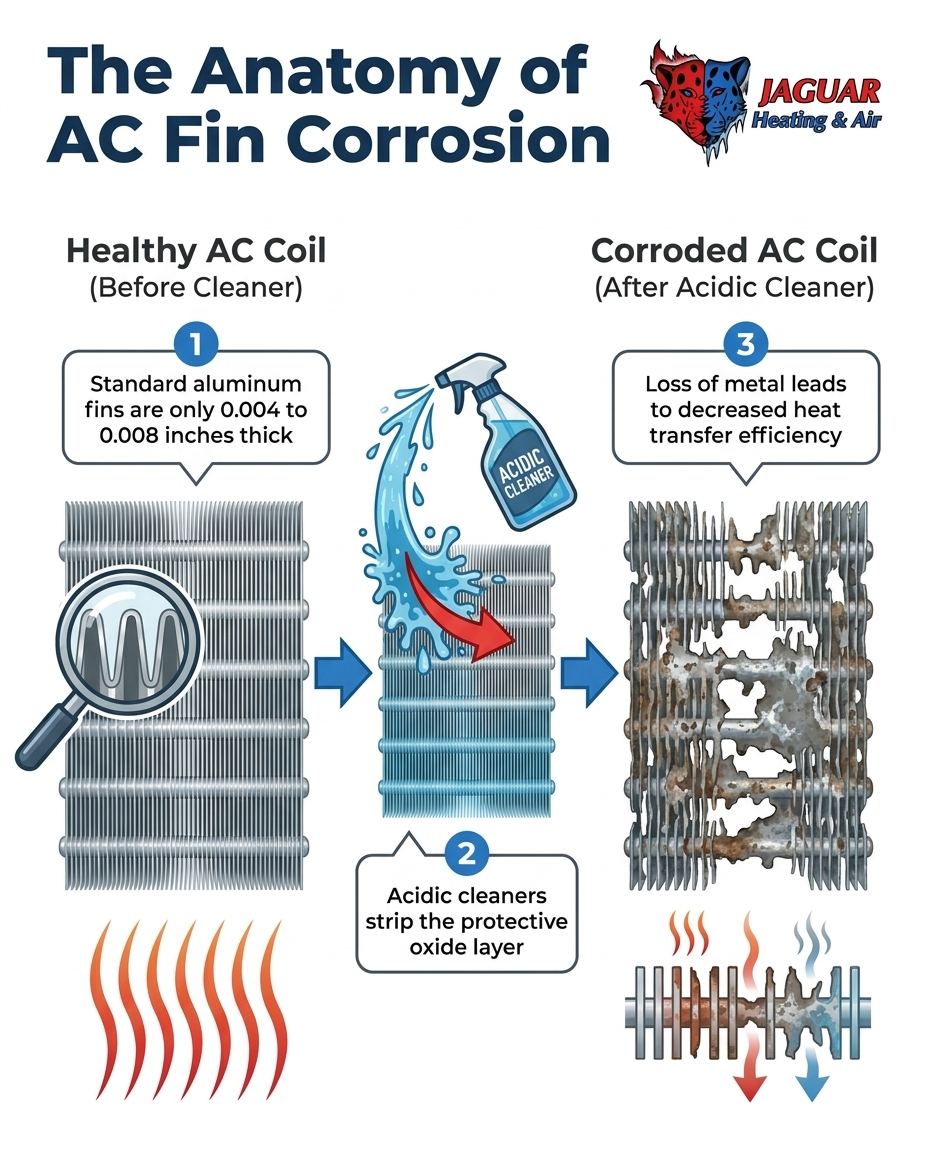
To understand why harsh chemicals are so destructive, we have to look at the underlying chemistry of your outdoor air conditioning unit. The coils inside your condenser are surrounded by hundreds of closely spaced aluminum fins. These fins act like a radiator, pulling heat out of the refrigerant and dispersing it into the outside air. Because they need to transfer heat rapidly, modern HVAC aluminum fins are manufactured to be incredibly thin—typically measuring between 0.004 and 0.008 inches thick. For context, that is roughly the thickness of a single sheet of copy paper.
The Problem: Aggressive Chemical Reactions
When acidic coil cleaners are used, which often contain potent ingredients like hydrofluoric or phosphoric acid, a violent chemical reaction takes place. The foaming action you might see isn't just lifting dirt; it is actively reacting with the aluminum itself. The acid breaks down the oxidized surface of the metal, dissolving the top microscopic layer of the fin.
The Cause: Stripping Metal for a Quick Clean
The "bright" appearance left behind by these chemicals is actually the result of the acid physically removing a layer of the metal to expose raw, unoxidized aluminum underneath. In our years of inspecting prematurely failing units, we've seen how every time an acidic cleaner is applied, the fins become thinner, weaker, and more susceptible to pitting. Pitting creates microscopic craters on the surface of the fins, which ironically gives dirt and debris more surface area to cling to in the future.
The Solution: Safe, Mechanical Alternatives
Because the aluminum is so delicate, the only truly safe way to maintain it is through non-destructive methods. This involves carefully lifting dirt away from the metal rather than dissolving the metal to remove the dirt. That same principle of preventing unnecessary damage is exactly why we never recommend hose-washing your AC coils or blasting them with harsh acids. Especially during early fall (September) end-of-cooling-season maintenance, when the system has been running hard for months, our priority is always to clean the equipment without compromising its structural integrity.
Why Summer Dust Settles Heavy by September
Your outdoor air conditioning unit is essentially a giant outdoor vacuum cleaner. Whenever the system is running, the large fan at the top of the condenser pulls thousands of cubic feet of air through the aluminum fins every minute. This airflow is necessary to carry heat away from your home, but it also draws in everything suspended in the outside air.
With Sacramento's dry, Mediterranean climate and triple-digit summer heat, our local environment creates the perfect storm for heavy particulate accumulation. When our crews are out in the field from May through August, we see how the prolonged lack of rain means that dust, pollen, and agricultural particulates remain airborne and are constantly pulled into your HVAC equipment. By the time September arrives and we transition to pre-heating-season tune-ups, this constant airflow has plastered a thick layer of debris across the delicate condenser fins.
What gets trapped in your coils over the summer:
• Baked-on dust: The intense summer heat bakes fine dirt directly onto the metal surfaces, creating a restrictive blanket.
• Organic matter: Cottonwood fluff, grass clippings, and dried leaves get wedged deep between the tight fin spacing.
• Airborne pollutants: Vehicle exhaust and regional agricultural dust settle into the microscopic grooves of the equipment.
By early fall, this baked-on debris severely restricts airflow, acting like an insulating blanket that traps heat inside the system and forces your compressor to work much harder than it should. This heavy particulate accumulation impacts overall system efficiency and can even influence the need for broader indoor air quality solutions if your system is struggling to breathe. While cleaning is absolutely necessary for homeowners in the Sacramento region at this time of year, the heavy, hardened nature of this dust is exactly why some technicians reach for harsh acids—and exactly why we insist on safer alternatives.
The Hidden Cost of Quick-Fix Brighteners: The Truth About Chemical Coil Cleaners and Your AC's Longevity
The long-term financial and operational consequences of using chemical coil cleaners are severe. Major HVAC manufacturers consistently issue strong warnings against using harsh chemical brighteners on modern thin-gauge fins. When these guidelines are ignored for the sake of a quick visual win, we unfortunately see the homeowner ultimately left paying the price.
The Degradation Process
When fins are chemically stripped, they lose their heat transfer efficiency. The microscopic pitting caused by the acid disrupts the smooth, laminar airflow over the metal. Instead of air gliding effortlessly through the fins, it encounters turbulence. This turbulence, combined with the loss of metal mass, means the system can no longer reject heat efficiently. Your air conditioner has to run longer cycles, consume more electricity, and operate at higher internal pressures just to achieve the same level of cooling.
The Path to Premature Failure
This added strain does not happen in a vacuum. Higher operating pressures put immense stress on the compressor—the most vital and expensive component of your entire system. Prioritizing a quick shine during routine maintenance often leads directly to the need for premature AC repair services due to corrosion, restricted airflow, and overworked electrical components—a pattern our team sees far too often.
• Immediate Visual Result — Acidic Chemical Brighteners: Unnatural, bright shiny metal — pH-Balanced Foaming Cleaners: Clean, natural aluminum finish
• Chemical Action on Metal — Acidic Chemical Brighteners: Dissolves the top layer of aluminum — pH-Balanced Foaming Cleaners: Lifts dirt without reacting with metal
• Impact on Fin Integrity — Acidic Chemical Brighteners: Causes microscopic pitting and thinning — pH-Balanced Foaming Cleaners: Preserves the factory thickness and strength
• Long-Term System Health — Acidic Chemical Brighteners: Accelerates corrosion and reduces lifespan — pH-Balanced Foaming Cleaners: Maintains optimal heat transfer efficiency
At Jaguar Heating & Air, our commitment is to protective, long-term maintenance practices. We explicitly refuse to use shortcut chemical brighteners that degrade your equipment. We understand that for a homeowner in the Sacramento region, shiny coils do not equal healthy coils if the metal's structural integrity has been compromised. Protecting your investment means choosing methods that preserve the equipment, not slowly destroy it.
Professional Methods for Preserving Equipment Life
Safe, non-destructive cleaning requires patience, the right tools, and a deep understanding of HVAC mechanics. We believe in thorough, accurate diagnostics and careful workmanship over aggressive quick fixes. For instance, one summer customer was previously told that their entire unit needed replacement. Our technician took the time to inspect the system and the ductwork, identified that the real issue was a failing duct, and replaced the duct to get the system working perfectly again. We apply that exact same philosophy of careful, precise care to our coil cleaning process.
When you invest in professional AC maintenance, you should expect a comprehensive approach that prioritizes the long-term health of your system. Here is how professional, non-destructive coil cleaning is properly executed by our team:
1. Careful Mechanical Removal: Before any liquids are introduced, our professionals start by mechanically removing dry debris. Using specialized soft-bristle brushes and high-powered vacuums, technicians gently lift away the heavy blanket of summer dust, cottonwood fluff, and leaves. This prevents dry dirt from turning into a thick mud when wet.
2. Application of pH-Balanced Foaming Cleaners: Instead of harsh acids, we use specialized, pH-balanced foaming agents. These cleaners are formulated to break the bond between the dirt and the metal without chemically reacting with the aluminum itself. The foam expands deep into the fin spacing, pushing trapped debris outward safely.
3. Low-Pressure Rinsing: Once the foaming agent has lifted the dirt, the coils are rinsed using a controlled, low-pressure water flow. High-pressure washing is avoided, as the force of the water can easily bend or flatten the delicate 0.004-inch fins, which would block airflow completely.
4. Airflow and Performance Verification: Proper maintenance isn't just about cleaning; it's about restoring function. After the cleaning process, our technicians verify that the heat transfer efficiency has improved, ensuring the system can breathe easily.
Especially during early fall (September) end-of-cooling-season maintenance, this comprehensive servicing plan ensures that baked-on debris doesn't harden during the off-season, protecting your system's efficiency for the months and years ahead.
Frequently Asked Questions About Coil Cleaning
Are chemical coil cleaners safe for ACs?
It depends entirely on the pH level of the cleaner being used. Acidic cleaners are not safe for modern air conditioners because they achieve their cleaning power by stripping away microscopic layers of the metal. Conversely, pH-balanced cleaners are completely safe, as they are formulated to lift dirt and grime without causing any chemical reaction with the delicate aluminum components.
Why do AC fins corrode?
AC fins corrode when their protective oxide layer is compromised, exposing the raw aluminum to the elements. Environmental factors like moisture, regional agricultural dust, and airborne pollutants naturally contribute to this wear over time. However, the use of harsh, acidic chemical cleaners drastically accelerates this oxidation process by intentionally eating away the metal's protective barrier, leading to rapid pitting and decay.
Can you use coil cleaner on aluminum fins?
Yes, but you must use the right type of cleaner to avoid causing permanent damage. Only non-acidic, specifically formulated foaming cleaners should be applied to aluminum fins. Because the fins on your outdoor unit are exceptionally thin, using the wrong chemical will eat away the aluminum, compromising the structural integrity of the system and reducing its ability to cool your home efficiently.
What do professionals use to clean AC coils?
Our technicians at Jaguar Heating & Air use a combination of safe mechanical tools and specialized chemical agents. The process typically begins with soft-bristle brushes and vacuums to remove heavy, dry debris from the surface. Following that, we apply non-destructive, pH-balanced foaming agents that safely push embedded dirt out from between the fins without harming the metal.
Why is early fall the best time to clean outdoor coils?
Early fall is the ideal time for coil cleaning because it addresses the heavy particulate buildup that accumulates over the long, dry summer. Removing this baked-on dust before the off-season prevents the debris from hardening or trapping moisture against the metal during wetter months. For homeowners in the Sacramento region, this timely maintenance also ensures optimal efficiency if the system operates as a heat pump during the winter.
Protecting Your Investment for Seasons to Come
Maintaining your home's cooling system requires a delicate balance between thorough cleaning and careful preservation. As we've explored, avoiding harsh, acidic chemicals is the single most important key to maintaining the structural integrity of your outdoor unit. True professional maintenance prioritizes long-term performance and efficiency over a quick, destructive shine.
As our team helps Sacramento homeowners prepare for the changing weather, remember that the truth about chemical coil cleaners and your AC's longevity ultimately comes down to the methods your technician chooses to employ. By scheduling an early fall (September) end-of-cooling-season maintenance visit with a team that refuses to take harmful shortcuts, you ensure your system remains efficient, reliable, and protected for many seasons to come.
Recent Posts
Why We Inspect Your Ductwork's Mastic Seal During Cooling Diagnostics
Before transitioning to fall heating, checking the 1990s-era mastic tape on your ductwork is crucial. Degraded attic seals waste expensive conditioned air long before your AC unit fails.
What a Rattling Outdoor Fan Blade Means for Your AC's Lifespan
A vibrating condenser fan creates micro-vibrations that act as a ticking time bomb for delicate copper lines. Find out why you shouldn't ignore this fall noise.
Why We Test Your AC's Amp Draw During Late Summer Maintenance
Even if your vents are blowing cold air, months of intense heat can push your compressor to the brink. We measure invisible electrical fatigue to catch stressed parts before a total breakdown.