.avif)
The Financial Math of Repairing vs. Replacing a Failed Compressor
A dead compressor on an aging AC system forces a tough choice. We break down the percentage-based lifespan math so you can confidently decide between a heavy repair and a full replacement.
A dead compressor on an aging AC system forces a tough choice. We break down the percentage-based lifespan math so you can confidently decide between a heavy repair and a full replacement.

Is Replacing a Failed Compressor on an Older AC Worth the Investment?
Are you staring at a massive repair estimate and wondering if the financial math of repairing vs. replacing a failed compressor actually makes sense for your home? You are not alone in asking this question. When your cooling system starts blowing warm air during the September post-summer transition, the frustration is immediate. You have just survived months of intense heat, and right as the season shifts, the most critical component in your HVAC system decides to quit. The compressor is the absolute heart of your air conditioning system, responsible for pumping refrigerant and facilitating the heat transfer that keeps your home comfortable. Because of its vital role and complex installation requirements, a compressor failure represents the steepest repair bill in the entire HVAC industry.
This leaves homeowners facing a difficult decision point: do you authorize a massive repair on an aging unit, or do you redirect that investment toward a completely new, energy-efficient system? Making this choice based on emotion or immediate panic often leads to regret. Instead, our team at Jaguar Heating & Air always recommends using an objective, percentage-based mathematical framework to guide your decision. By removing the guesswork and analyzing system lifespan, efficiency degradation, and overall return on investment, you can determine exactly which path protects your household budget in the long run.
If you need immediate guidance on evaluating your system's condition, our comprehensive air conditioning services can provide the expert diagnostic you need to make an informed choice.
The Anatomy of a Late-Season Compressor Failure
Understanding why compressors typically fail at this specific time of year helps validate your experience and sets up the mechanical reality of your decision. A compressor does not usually die overnight without a cause; its failure is the final result of cumulative thermal fatigue. In our years serving the Sacramento area, we see firsthand how local systems endure extreme operational stress. Sacramento experiences over 30 days of triple-digit summer heat annually, which forces air conditioning equipment to run continuously just to maintain a basic level of indoor comfort. This relentless operation degrades internal compressor components much faster than in milder climates, accelerating the wear and tear on your entire system.
By the time September arrives, your equipment has been pushed to its absolute limits for months. Our technicians see this pattern constantly. Just recently, a Sacramento homeowner called us during a late-season heat spike when their house simply stopped cooling. One of our expert technicians arrived, thoroughly explained the problem—a significant component failure caused by heavy summer strain—and presented multiple options. Because they understood exactly what was wrong, they could make an informed choice, and their house was soon cooling effectively again. When a compressor finally locks up or shorts out in the early fall, it is rarely an isolated event. It is usually a glaring symptom of systemic aging, signaling that the equipment has already consumed the vast majority of its functional lifespan.
If you are experiencing the warning signs of a struggling system, scheduling an AC repair diagnostic is the first step toward understanding the true condition of your equipment.
How Cumulative Heat Strain Breaks Down Equipment
The mechanical breakdown of a compressor follows a predictable sequence when subjected to extreme seasonal stress. Based on what our crews uncover in the field, here is how continuous heat exposure ruins this vital component:
1. Continuous cycling during peak heat waves: When temperatures remain above 100 degrees, the compressor rarely gets a chance to rest and cool down. This constant running generates internal heat that slowly degrades the motor windings.
2. Lubrication breakdown inside the compressor: Just like a car engine, a compressor relies on specific oils to keep moving parts frictionless. Extreme, prolonged heat changes the viscosity of this oil, reducing its ability to lubricate and causing internal metal-on-metal grinding.
3. Electrical stress on aging capacitors and relays: As the system ages, starting components grow weak. A failing capacitor forces the compressor to pull significantly more electrical current to start up, which overheats the unit and eventually causes catastrophic electrical failure.
Applying the 50% Rule and Avoiding the Sunk-Cost Fallacy
The Problem: Homeowners often feel trapped when presented with a heavy repair quote for a 12-year-old system. The initial reaction is usually a desire to just fix the broken part, especially if you have already spent money on minor repairs over the last few seasons.
The Cause: This mindset is driven by the sunk-cost fallacy. In home maintenance, the sunk-cost fallacy is the psychological trap of wanting to "save" a doomed system simply because you have already invested heavily in its past upkeep. You feel that by replacing the system now, the money spent on last year's fan motor or contactor is wasted. However, putting a brand new, expensive compressor into a decade-old system is mathematically risky.
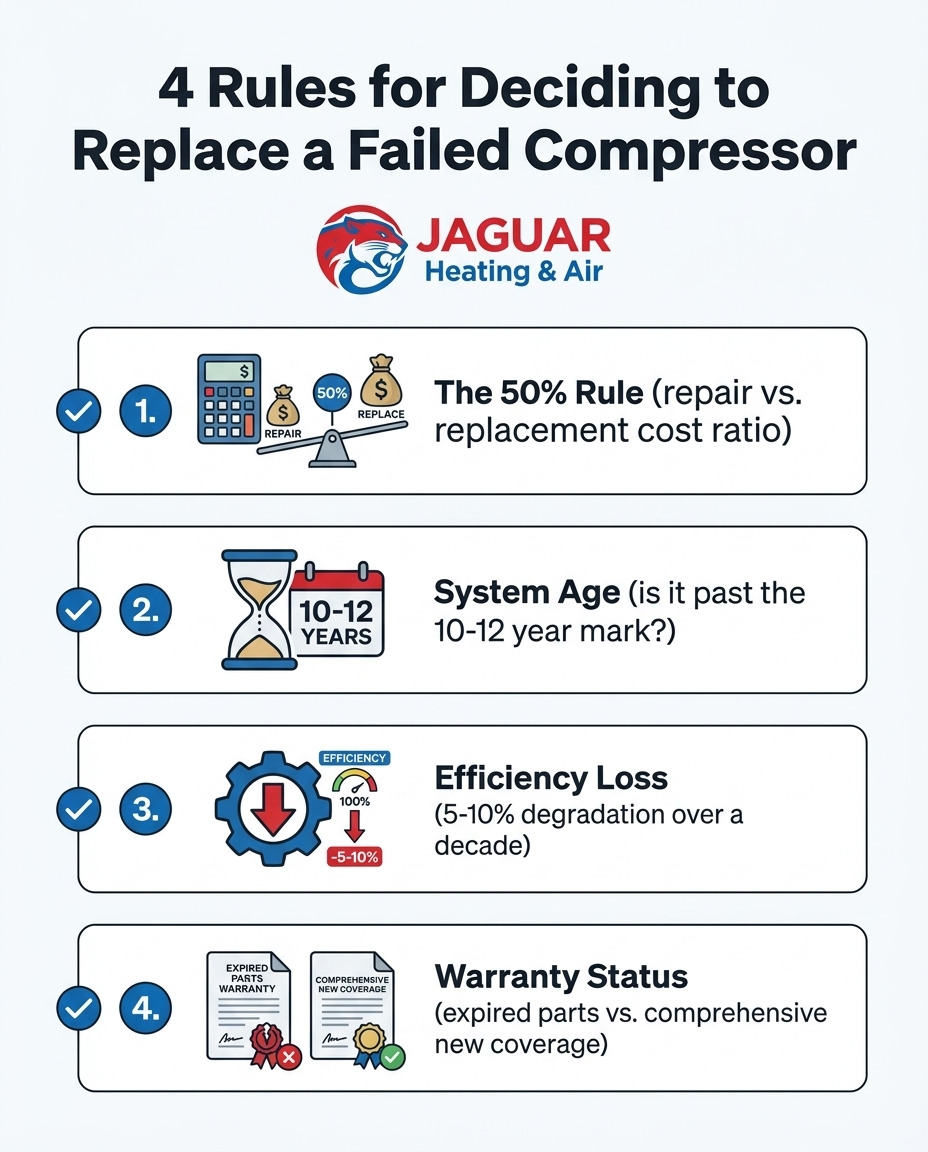
The Solution: To break free from emotional decision-making, our team at Jaguar Heating & Air relies on the 50% Rule. The rule is simple: if the cost to repair the unit equals or exceeds half the cost of a completely new system, replacement is mathematically optimal. When you apply this rule to a 12-year-old system, the decision becomes incredibly clear. The Department of Energy estimates the average lifespan of a central air conditioner at 15 to 20 years. Therefore, a 12-year-old unit is already entering the final 25% of its expected life. Investing half the cost of a new system into a machine that is statistically nearing the end of its functional life guarantees a poor return on investment.
The Hidden Costs of Patching an Aging System
When you focus entirely on the price of the compressor, it is easy to overlook the broader mechanical reality of your HVAC system. When we consult with homeowners, we always remind them that a new compressor does not reset the clock on the rest of your equipment. If you install a pristine, brand-new compressor into a 12-year-old system, that new part must now work alongside an aging evaporator coil, a tired blower motor, and degraded electrical components. The mismatch in component age often leads to poor performance and premature failure of the new part.
Furthermore, you must account for systemic efficiency loss. Air conditioning units typically lose 5% to 10% of their operational efficiency over a decade of heavy use. Even with a new compressor, your 12-year-old system will still consume significantly more electricity than a modern unit, meaning your monthly operational costs remain stubbornly high. There are also refrigerant compatibility issues to consider; older systems often rely on phased-out refrigerants that are increasingly difficult and expensive to source. When you compare the reliability of a patched, aging system against a fully matched, modern installation, the hidden costs of repairing become obvious. If you are exploring how modern technology improves performance, reading about deciding between a single-stage and variable-speed AC provides great insight into current efficiency standards.
Impending Component Failures to Watch For
If you choose to patch a 12-year-old system, our technicians warn you to be prepared for these subsequent failures that frequently follow a compressor replacement:
• Evaporator coil leaks: The indoor coil undergoes massive temperature swings and condensation cycles. After a decade, the metal weakens, leading to microscopic refrigerant leaks that are notoriously difficult to patch.
• Blower motor fatigue: The indoor fan works year-round for both heating and cooling. By year twelve, the bearings are worn, and the motor is highly susceptible to burning out.
• Degraded ductwork connections: While not part of the mechanical unit itself, the seals and insulation on older ductwork often fail over a decade, forcing your patched system to work even harder to cool the house.
• Component Lifespan — Patched 12-Year-Old System: Mixed (New compressor, old failing parts) — Brand New HVAC System: 100% new, factory-matched components
• Energy Efficiency — Patched 12-Year-Old System: Degraded (5-10% loss from original rating) — Brand New HVAC System: Maximum efficiency, lower monthly bills
• Refrigerant Type — Patched 12-Year-Old System: Likely older, expensive, or phased-out — Brand New HVAC System: Modern, environmentally compliant, readily available
• Warranty Protection — Patched 12-Year-Old System: Limited to the single replaced part — Brand New HVAC System: Comprehensive 10-year systemic coverage
Long-Term ROI: Efficiency Gains and Comprehensive Warranty Protection
To make the smartest financial decision, you must shift your focus from the immediate shock of the repair cost to the long-term return on investment of a full replacement. When you authorize a major repair, the warranty typically only covers that specific replacement part for a very limited time. If the blower motor fails two months later, you are paying out of pocket again. In stark contrast, a brand new system comes with a comprehensive 10-year warranty that covers all internal functional parts, providing a decade of absolute peace of mind.
Modern, high-efficiency systems also drastically reduce your monthly energy consumption. The technological advancements in compressor design and airflow management mean that a new unit can cool your home much faster while using a fraction of the electricity. Additionally, generally applicable energy rebates or tax credits may apply to qualifying high-efficiency installations, which further improves your return on investment (we always advise verifying current programs with your utility provider or a tax professional).
Of course, budget constraints are a real concern. One local Sacramento customer on a tight budget reached out to us during the early fall transition because their AC was blowing ambient air. A service tech arrived within the hour, explained the system failure, and proposed a solution that got the system fixed and providing cool air at a good price. When the failure is a minor component, a targeted repair is a massive win for your budget. But when the diagnosis is a catastrophic compressor failure on an aging unit, investing in AC replacement in Sacramento offers the predictable cooling and financial security that a band-aid repair simply cannot match.
Financing the Future Instead of Funding the Past
We completely understand that while the mathematical logic heavily favors replacement, the immediate upfront cost of a new system can be intimidating. A massive out-of-pocket repair bill is stressful, and stepping up to a full replacement feels like a major financial leap. This is exactly why flexible financing is a smart mathematical alternative to draining your savings on a doomed machine.
Financing converts a catastrophic, unexpected expense into manageable monthly investments. Instead of throwing good money after bad by funding the past, you are financing the future of your home's comfort. Because new systems operate so much more efficiently, you can actually leverage your monthly energy savings to help offset the cost of the financing payment over time.
At Jaguar Heating & Air, our commitment is to provide transparent cost breakdowns and honest lifespan assessments so you never feel pressured into a bad investment. Investing in a new system builds tangible equity in your home's infrastructure, whereas repairing a dead unit is the definition of a sunk cost. Exploring our HVAC financing options ensures you can secure reliable, efficient cooling without compromising your household budget.
Frequently Asked Questions
Is it worth replacing an AC compressor on a 12-year-old unit?
In our professional experience, the short answer is usually no. A 12-year-old system is already in the final quartile of its expected lifespan. Putting an expensive new compressor into an aging system leaves you vulnerable to other impending component failures, making a full replacement a mathematically wiser choice.
Should I repair or replace my AC compressor?
You should base this decision on the 50% Rule and the age of your equipment. If the repair cost approaches or exceeds half the cost of a new system, or if your unit is over a decade old, replacing the entire system provides a much better long-term return on investment.
How long does a replaced AC compressor last in an older system?
A replaced compressor can mechanically last for years, but the older system surrounding it usually fails much sooner. Because the new compressor must work with an aging evaporator coil and worn electrical components, the mismatched system often suffers subsequent breakdowns within a few seasons.
How does the repair-to-replacement cost ratio work for HVAC?
The repair-to-replacement cost ratio compares the quote of fixing your current unit against the total investment of a new installation. Industry standards suggest that if repairing costs 50% or more of a new unit, the math favors replacement, as you gain maximum efficiency and a comprehensive warranty.
Does replacing the compressor give me a new system warranty?
No, replacing a compressor only provides a limited warranty for that specific part. The rest of your aging components remain entirely unprotected. Upgrading to a completely new system is the only way to secure a comprehensive 10-year warranty covering all functional parts.
Making the Right Call for Your Home Comfort
Deciding between a major repair and a full system upgrade doesn't have to be a guessing game. By applying objective lifespan ratios and relying on experienced local technicians who understand the true toll of Sacramento's thermal fatigue, you can confidently avoid the sunk-cost trap. A clear, mathematical framework ensures you make a wise, long-term investment that provides reliable cooling and absolute peace of mind.
Recent Posts
HVAC Maintenance and Replacement Options: Comparing Heat Pumps vs. Gas Furnaces
Decide with confidence this fall. We break down heating options comparisons for homeowners choosing between a heat pump and gas furnace. See which is best.

Fall HVAC Startup Checklist: Diagnosing Burning Smells and System Red Flags
Deciding if that burning dust smell is normal? See why this seasonal home maintenance checklist is critical for catching heating failures before winter hits.

Fall HVAC Maintenance Troubleshooting: Decoding Furnace Startup Smells and Sounds
Is that burning dust smell normal? See what happens inside your system during fall startup and find home maintenance tips and troubleshooting to stay safe.