.avif)
What a Rattling Outdoor Fan Blade Means for Your AC's Lifespan
A vibrating condenser fan creates micro-vibrations that act as a ticking time bomb for delicate copper lines. Find out why you shouldn't ignore this fall noise.
A vibrating condenser fan creates micro-vibrations that act as a ticking time bomb for delicate copper lines. Find out why you shouldn't ignore this fall noise.

Is That Rattling Condenser Fan Just a Nuisance or a System Threat?
Are you hearing a distinct, metallic clatter from your outdoor unit and wondering exactly what a rattling outdoor fan blade means for your AC's lifespan? You are not alone. As we enter the September / early fall transition, many homeowners notice their air conditioning units sounding significantly louder than they did in May. Because the intense summer heat is finally starting to break, the temptation to ignore that annoying noise is strong. It is easy to assume that a rattling sound is just a loose screw or a harmless quirk of an aging system that can wait until next year.
Here is the reality: that rattling is rarely just a cosmetic nuisance. A vibrating fan blade creates high-frequency micro-vibrations that act as a ticking time bomb for the delicate internal components of your cooling system. Ignoring this symptom allows kinetic energy to slowly destroy critical parts from the inside out. If you want to protect your investment in your air conditioning systems, you need to address the root cause before a minor adjustment turns into a catastrophic failure requiring professional AC repair.
The Physics of a Rattling Fan: How Micro-Vibrations Travel
To understand why a noisy outdoor unit is so dangerous, we have to look at the mechanical physics of a spinning blade. Your outdoor condenser fan is designed to be perfectly balanced, much like the tires on your car. When everything is aligned, the fan spins smoothly at hundreds of revolutions per minute (RPM) to pull heat out of your home. However, it only takes a tiny imperfection to throw that balance off.
Common causes of blade imbalance:
• Debris impacts: Small twigs, hail, or yard debris striking the blade while it spins can create microscopic bends in the metal.
• Bearing wear: As the motor bearings degrade over time, the fan shaft develops a slight wobble, causing the entire assembly to vibrate.
• Accumulated dirt: Heavy, uneven layers of dirt and grime on one side of a fan blade can throw off the center of gravity.
When an unbalanced mass rotates at high speeds, it generates continuous kinetic energy. This energy does not just stay in the fan blade. It travels downward, seeking the path of least resistance. While you might be familiar with indoor airflow noises—like when your AC blower motor sounds like a jet engine—the vibrations from an outdoor condenser fan are entirely different. Indoor noises are often air-pressure related, whereas outdoor rattling is a physical, structural threat.
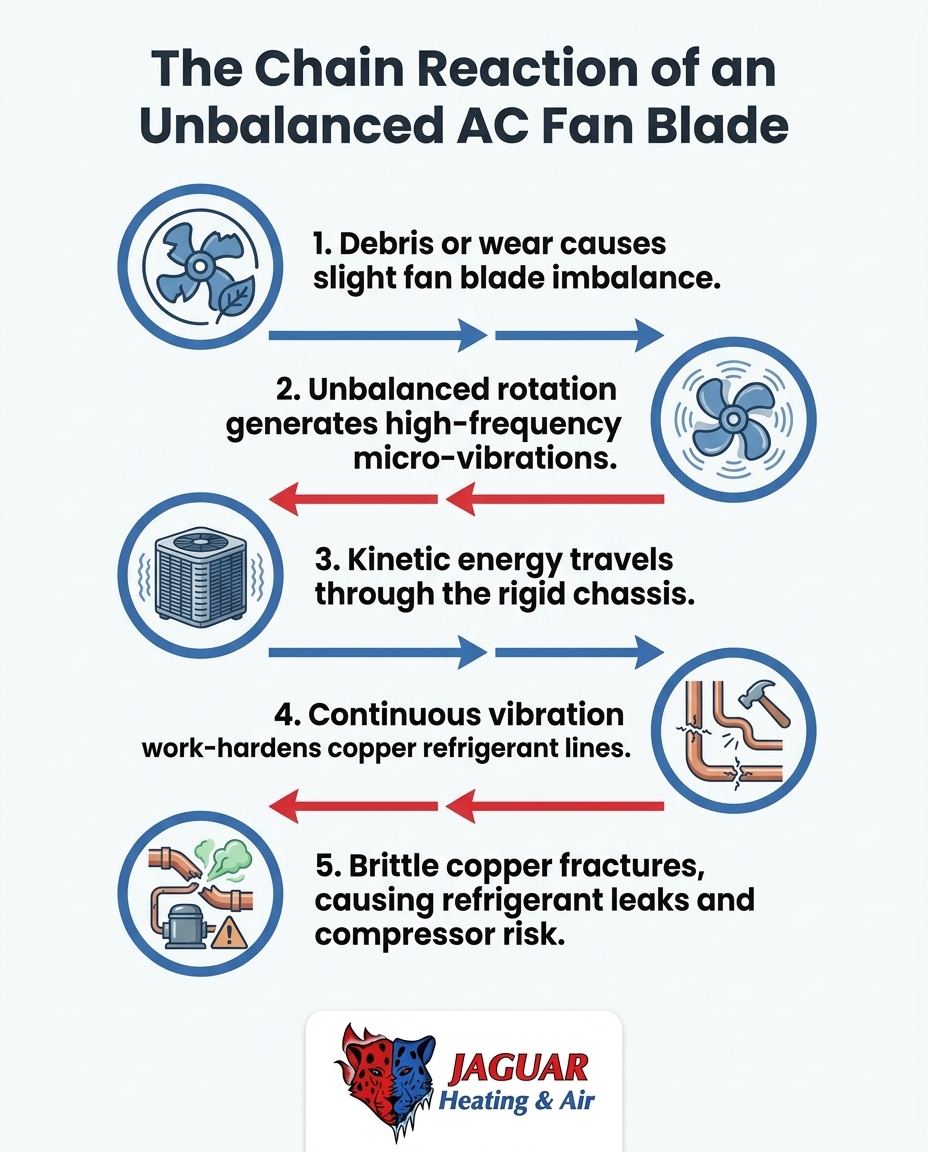
The Kinetic Chain Reaction
The damage happens in a predictable, sequential chain reaction that affects the entire outdoor unit:
1. Imbalance initiates at the blade assembly: The slightly bent or dirty blade begins to wobble as it spins, creating an uneven centrifugal force.
2. High-frequency vibration transfers to the motor mount: The wobble shakes the fan motor, placing immense stress on the mounting brackets and internal motor bearings.
3. Energy disperses through the rigid chassis: Because the motor is bolted directly to the metal frame of the condenser, the vibration travels through the chassis and directly into the delicate internal piping.
Enduring the Heat: The Cumulative Toll on Mechanical Balance
HVAC systems do not experience wear and tear evenly throughout the year. The climate you live in plays a massive role in how quickly mechanical degradation occurs. Here in the Sacramento Valley, our intense, prolonged summer heat waves force condenser fans to run for extended daily cycles. When temperatures consistently soar past the 100-degree mark, your outdoor unit might run for 10 to 14 hours a day just to keep your home comfortable.
Consider the math behind those extended run times. If your fan motor spins at 800 RPM, it completes 48,000 rotations every hour. Over a 12-hour cooling cycle, that is more than half a million rotations in a single day. If the fan blade is even slightly out of balance, that means the internal components of your AC are being shaken violently over half a million times a day.
This grueling operational demand compounds the mechanical stress on the system. What starts as a microscopic, silent imbalance in June slowly worsens over millions of rotations. By the time early fall arrives, the bearings are worn, the brackets are loose, and the system is rattling loudly enough for you to hear it from inside the house. This cumulative toll is exactly why investing in routine AC maintenance is so critical. Proactive check-ups catch these microscopic imbalances before the long summer hours amplify them into destructive vibrations.
Metal Fatigue: Why Copper Refrigerant Lines Are the Ultimate Victim
The Problem: When homeowners hear a rattling fan, they usually worry about the fan motor burning out. While motor failure is a real risk, the far more dangerous threat lies hidden inside the unit: the copper refrigerant lines.
The Cause: Copper is a relatively soft, malleable metal. This makes it perfect for shaping into the complex coils and lines required for an air conditioner. However, copper is highly susceptible to a metallurgical process known as "work-hardening." If you take a metal paperclip and bend it back and forth repeatedly, the metal gets hot, becomes brittle, and eventually snaps. The exact same physics apply to your refrigerant lines. As the high-frequency vibrations from the unbalanced fan travel through the chassis, the copper lines absorb that kinetic energy. Over weeks and months of continuous shaking, the soft copper hardens, loses its flexibility, and becomes brittle.
The Solution: Once the copper becomes brittle, microscopic fractures begin to form at the joints and bends. These fractures lead to slow, hard-to-detect refrigerant leaks that cripple your system's efficiency. As the refrigerant level drops, the compressor has to work twice as hard to cool your home, eventually leading to a complete compressor burnout.
We see the results of delayed action frequently. One customer reached out in the morning when their AC unit simply stopped functioning correctly after weeks of running loudly. Our technician arrived, explained how the mechanical vibration had compromised the unit, and had the underlying issue fixed before noon, leaving the customer impressed with the rapid turnaround. Catching the symptom early prevented a much larger repair.
Because dealing with pressurized refrigerant requires specialized gauges, recovery equipment, and EPA certification, you should never attempt DIY repairs on copper lines or fan balancing. If your unit is rattling, thorough leak inspections and mechanical balancing by a licensed professional are strictly required.
• Fan Motor Bearings — Normal Operating Wear: Gradual friction loss over 10+ years — Vibration-Induced Wear: Rapid degradation and uneven grinding
• Copper Refrigerant Lines — Normal Operating Wear: Remain flexible and sealed — Vibration-Induced Wear: Work-harden, become brittle, and fracture
• Compressor Strain — Normal Operating Wear: Standard electrical load — Vibration-Induced Wear: Overheats due to slow refrigerant leaks
The September Illusion: Why Dropping Temperatures Don't Fix Mechanical Issues
As the September / early fall transition brings cooler evenings, a dangerous psychological barrier sets in for many homeowners. It is incredibly common to adopt a "nuisance noise" mindset. The logic goes like this: The AC is rattling, but we only need it for a few more weeks. I'll just ignore it, shut it down for the winter, and worry about it next spring.
This is the September illusion. Mechanical physics do not pause just because the weather cools down. If an unbalanced fan has already caused micro-fractures in your copper refrigerant lines, that leak does not stop when you turn the thermostat off. Leaving a compromised system to sit idle over the winter allows those slow leaks to drain the refrigerant entirely.
Furthermore, an unbalanced system is highly vulnerable to sudden operational stress. If we experience a late-season heat spike in October, forcing your compromised unit to run at full capacity, the weakened parts are highly likely to fail entirely. Alternatively, the system will sit empty all winter and suffer a catastrophic compressor failure immediately upon startup the following spring. Dropping temperatures reduce your immediate need for cold air, but they do absolutely nothing to reverse the mechanical damage happening inside the chassis.
Advanced Diagnostics: Stopping Compressor Failure Before It Starts
Fixing a rattling condenser is rarely as simple as walking outside with a screwdriver and tightening a loose panel. While a loose screw might muffle the noise temporarily, it does nothing to stop the rotating mass from shaking the internal copper lines. True protection requires comprehensive mechanical balance diagnostics.
The diagnostic difference: When you rely on expert local diagnostics, technicians track the source of the vibration to its absolute root cause. They measure the pitch of the fan blades, check the motor shaft for uneven play, and inspect the structural integrity of the motor mounts. Most importantly, they use sensitive leak-detection equipment to ensure the compressor and copper refrigerant lines haven't already been compromised by the shaking.
At Jaguar Heating & Air, our expert local diagnostics focus on catching these root-cause mechanical imbalances before they escalate into catastrophic compressor failures. We believe in providing prompt response times and clear, honest explanations of what is actually happening inside your equipment. We have seen firsthand what happens when issues are ignored. For instance, one Vacaville customer reached out in the spring after an unresolved mechanical issue escalated over the winter, ultimately requiring a full AC unit and coil replacement. Catching the vibration early could have changed that outcome.
The best way to prevent these issues from developing in the first place is through ongoing, structured care. Enrolling in an HVAC maintenance membership ensures that your system's mechanical balance is verified by professionals before the grueling summer heat begins, keeping your fan running smoothly and silently all season long.
Frequently Asked Questions About Noisy AC Fans and Lifespan
Why is my AC outside unit rattling?
Your AC outside unit is most likely rattling due to a mechanical imbalance in the fan blade, failing motor bearings, or loose exterior panels. When debris strikes the fan or dirt builds up unevenly, the blade becomes off-balance and shakes the entire unit as it spins. You can often differentiate a loose panel from a deep mechanical issue by carefully listening: if pressing firmly on the exterior metal casing stops the noise, it may just be a loose screw. However, if the deep vibration continues beneath the panel, the fan motor assembly is compromised and requires professional attention.
Is it safe to run a rattling AC?
No, running a rattling AC is not safe for the equipment, as it risks compounding the mechanical damage with every rotation. In the short term, the vibration will cause increased wear on the motor bearings, causing the fan to draw more electricity and run hotter. In the long term, ignoring the noise allows kinetic energy to travel into the unit's delicate copper piping, leading to metal fatigue, refrigerant leaks, and ultimately, total compressor failure.
What happens if an AC fan blade is unbalanced?
An unbalanced fan blade transfers high-frequency kinetic energy into the motor mount and down through the unit's rigid chassis. Because the blade is spinning at hundreds of revolutions per minute, even a microscopic imbalance generates a massive amount of shaking force. This constant vibration accelerates wear on the motor bearings and forces adjacent copper refrigerant piping to absorb the kinetic shock, which severely shortens the lifespan of the entire system.
Can a noisy AC fan damage the compressor?
Yes, a noisy AC fan can severely damage the compressor by causing the copper refrigerant lines to fracture and leak. The compressor relies on a precise volume of refrigerant to cool both your home and the compressor motor itself. When the fan's vibrations crack the copper lines, the refrigerant slowly escapes. Operating with low refrigerant forces the compressor to overwork, overheat, and eventually burn out completely—turning a fan issue into the most expensive repair possible.
Why do I only notice the rattling at the end of the summer?
You typically notice the rattling at the end of the summer because mechanical wear and tear compounds over months of heavy, continuous usage. A fan blade that is only slightly out of balance in June might not make an audible noise. However, after running for hundreds of hours during intense summer heat waves, the constant micro-vibrations loosen brackets and wear down bearings. By early fall, the progressive damage has worsened enough to create a loud, undeniable rattle.
Will tightening the exterior screws stop the micro-vibrations?
Tightening exterior screws will only quiet a loose panel, but it will never stop the underlying micro-vibrations caused by an unbalanced rotating mass. Many homeowners mistakenly assume the root cause is fixed just because the symptom is slightly muffled. If the fan blade or motor shaft is unbalanced, the kinetic energy will continue to shake the internal copper lines regardless of how tight the outer casing is, leaving your system vulnerable to hidden metal fatigue.
Protect Your AC's Lifespan Before Winter Hits
The short answer is clear: a rattling outdoor fan is a serious mechanical warning sign. As we have seen, the physics of micro-vibrations prove that ignoring a rattle turns a simple fan adjustment into a major system failure involving fractured copper lines and burned-out compressors. Do not fall for the illusion that cooler weather fixes mechanical damage. Secure your system's integrity now before the off-season allows slow leaks to drain your refrigerant. Reach out to a local professional to schedule comprehensive diagnostics, and ensure your system is perfectly balanced and ready to perform when you need it most.
Recent Posts
Why We Test Your AC's Amp Draw During Late Summer Maintenance
Even if your vents are blowing cold air, months of intense heat can push your compressor to the brink. We measure invisible electrical fatigue to catch stressed parts before a total breakdown.
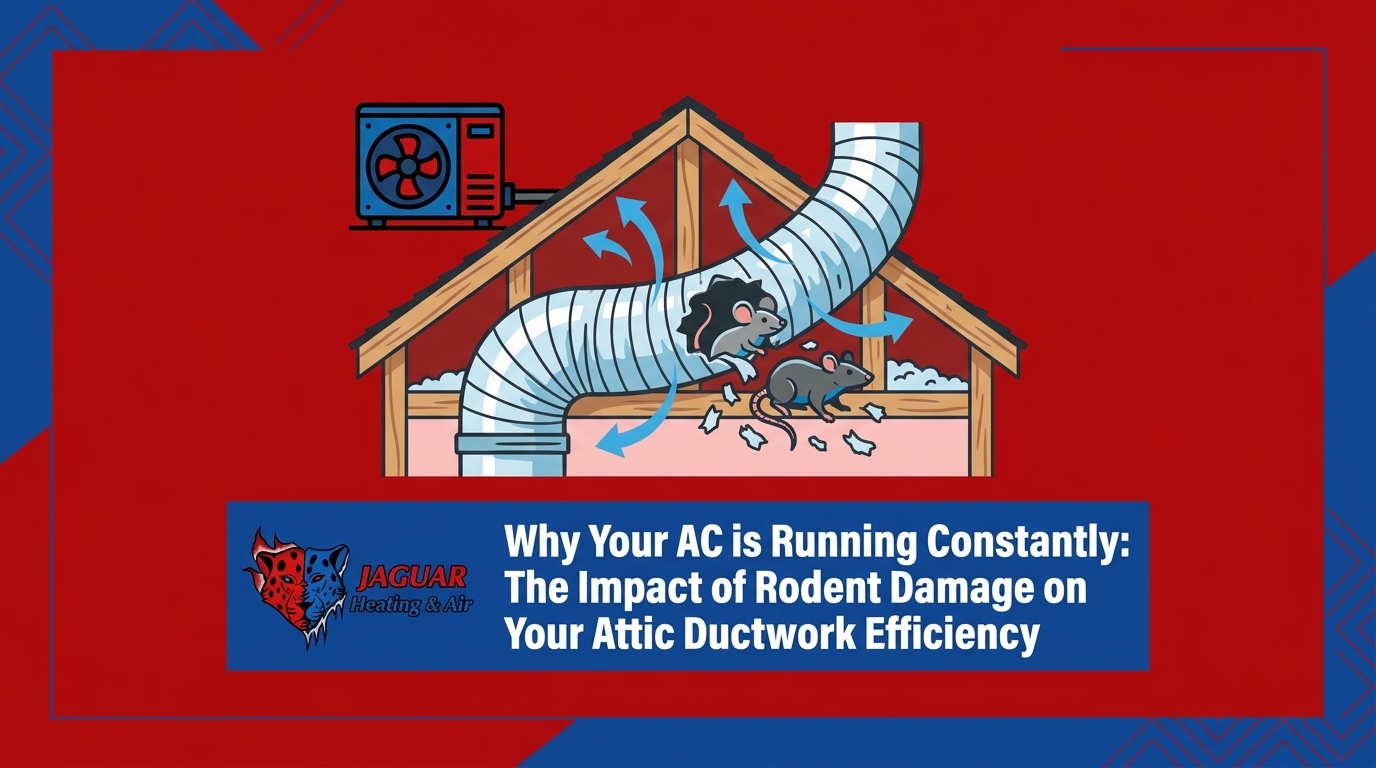
The Impact of Rodent Damage on Your Attic Ductwork Efficiency
If your cooling system runs constantly but your home stays warm, roof rats may have chewed through your flex ducts. See why a tape patch isn't enough to safely restore your system's airflow.
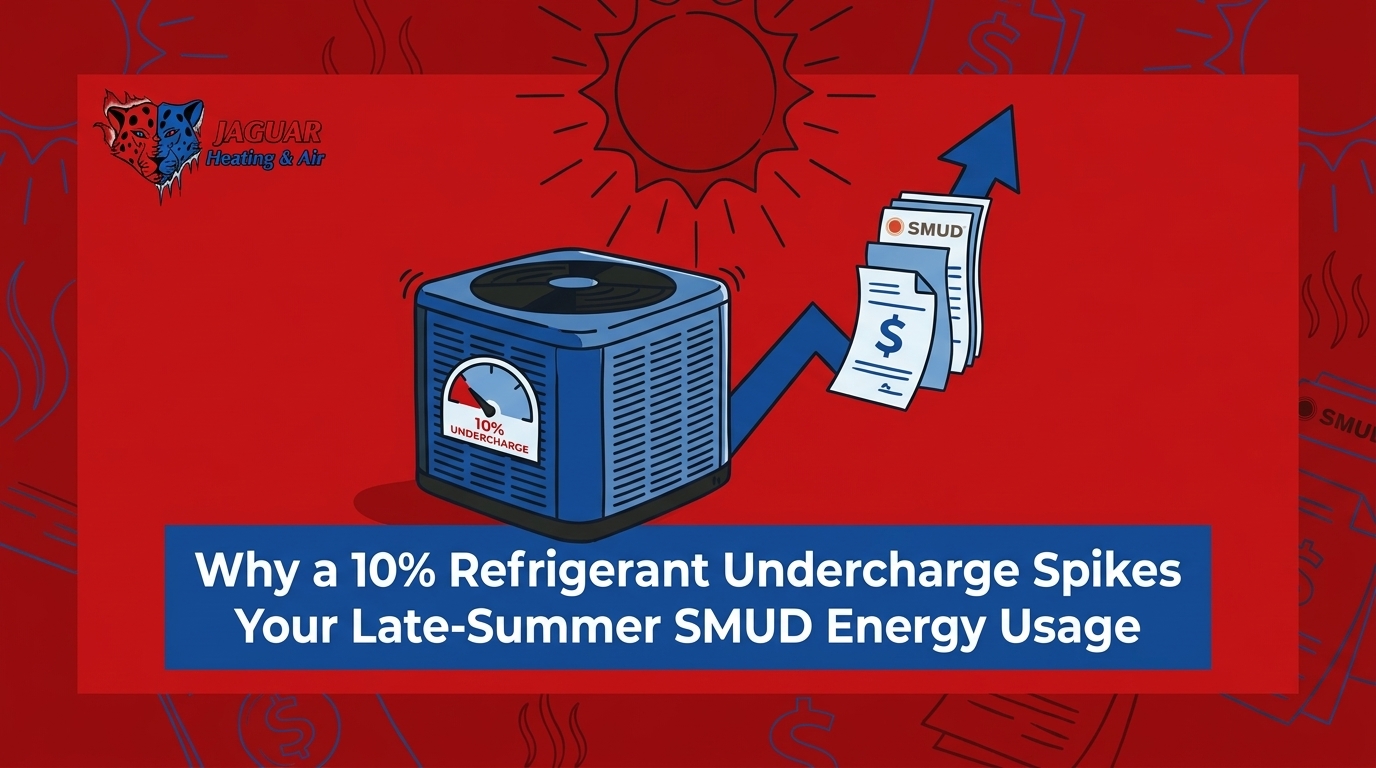
How Proper Refrigerant Charge Impacts Your Monthly SMUD Bill
Blaming lingering Sacramento heat for high September electricity usage? A minor 10% refrigerant undercharge forces your AC to run drastically longer, quietly multiplying your energy costs.