.avif)
The Difference Between a Clogged Filter Drier and a Bad TXV Valve
An AC that blows warm air isn't always leaking refrigerant—it might be suffering from a flow restriction. Find out how technicians trace the bottleneck to restore your cooling.
An AC that blows warm air isn't always leaking refrigerant—it might be suffering from a flow restriction. Find out how technicians trace the bottleneck to restore your cooling.

The Myth of the Freon Leak: When Your System is Actually Starving
Adding refrigerant to a warm-blowing air conditioner doesn't automatically fix the root cause of the problem—it often just masks a deeper mechanical failure. The assumption that a struggling system just needs a quick recharge is one of the most common misconceptions in home cooling. In reality, understanding the difference between a clogged filter drier and a bad TXV valve is often the real key to solving why your system is starving for Freon.
When your air conditioner runs continuously but only pushes lukewarm air through your vents, it is easy to assume the refrigerant has leaked out. This scenario is incredibly common during the September transition season, when cooling equipment has been running hard for months and is finally pushed to its limits by lingering late-summer heatwaves. These late-season temperature spikes push already stressed AC systems to their breaking point right before fall.
However, a system that appears to be low on refrigerant is frequently suffering from a flow restriction instead. The refrigerant is still inside the copper lines, but a physical bottleneck is preventing it from circulating at the correct pressure and volume. Understanding why professional diagnostics are necessary to pinpoint this exact restriction—rather than blindly adding refrigerant—can save you from catastrophic equipment failure.
If you need professional help assessing your Air Conditioning system, scheduling an expert AC repair is the safest way to protect your investment.
Understanding Refrigerant Flow Restrictions
The Problem: Mimicking a Leak
To understand why a flow restriction is so often mistaken for a leak, it helps to know how your air conditioner moves heat. Your cooling system operates on a closed loop, circulating refrigerant between the indoor evaporator coil and the outdoor condenser unit. When a physical blockage occurs anywhere in this liquid line, it prevents the refrigerant from circulating at the proper volume and pressure.
This blockage causes the indoor evaporator coil to starve. Because there is not enough liquid refrigerant entering the coil to absorb the heat from your home's air, the system blows warm air. To an untrained eye, or even on a technician's initial gauge readings, this low suction pressure looks exactly like a system that is low on refrigerant.
The Cause: Physical Blockages
Flow restrictions do not happen without a reason. They are almost always the result of contamination inside the closed refrigerant loop. Moisture, copper shavings, degraded oil, or even excess brazing soot from a previous repair can travel through the lines until they get lodged in a narrow passageway.
One Sacramento homeowner recently reached out to have their air conditioner checked for leaks because it was blowing warm air. They appreciated the 24-hour service availability as a technician arrived quickly and efficiently. Instead of simply adding refrigerant, the technician identified a severe flow restriction, addressed the underlying blockage, and restored the system's cooling capacity without unnecessary guesswork.
The Solution: Diagnostic Verification
Deeper investigation is always required when an air conditioner shows signs of low pressure. If someone attempts topping off Freon in a system that is actually restricted, the results can be disastrous. The added refrigerant has nowhere to go, causing pressure to build up to dangerous levels in the outdoor unit, which can permanently damage the compressor.
What Happens When a Filter Drier Gets Clogged?
Every standard air conditioning system features a component called a liquid line filter drier. Think of the filter drier as the kidney of your cooling system. Its primary role is to absorb moisture and trap microscopic debris before those contaminants can travel further down the line and reach the delicate metering device.
Inside the filter drier, a desiccant core actively pulls moisture out of the refrigerant, while a fine mesh screen catches physical particulates. Over time, or following a poor installation where lines were not properly purged with nitrogen, this screen can become overwhelmed. When a filter drier gets clogged, it restricts the flow of liquid refrigerant prematurely.
The primary diagnostic symptoms of a clogged filter drier include:
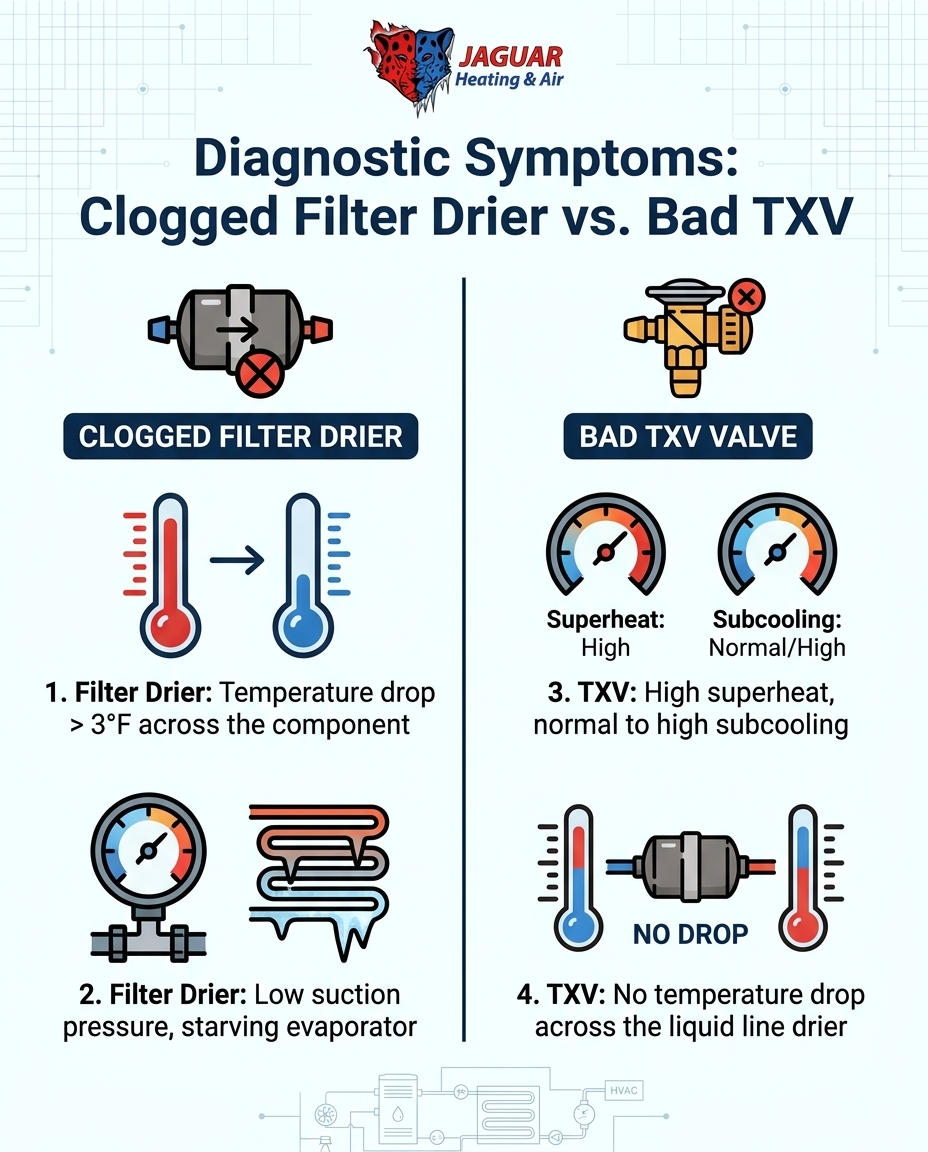
• A physical temperature drop: Professionals look for a noticeable temperature drop (often greater than 3 degrees Fahrenheit) across the filter drier itself. The line entering the drier will feel warm, while the line exiting it will feel noticeably cooler.
• Low suction pressure: The indoor coil receives a fraction of the refrigerant it needs, causing the pressure on the suction line to plummet.
• Continuous operation: The thermostat never reaches its target temperature, causing the system to run nonstop while blowing warm air.
Because the filter drier is located before the metering device on the liquid line, a severe restriction here means the downstream components are starved of refrigerant. Professionals use precise superheat and subcooling measurements to verify this. Even if the metering device is in perfect working order, it cannot do its job if the filter drier is choking off the supply.
The Role and Failure of the TXV (Thermostatic Expansion Valve)
If the filter drier is the kidney of the system, the Thermostatic Expansion Valve (TXV) is the brain of the indoor coil. The TXV is a precision metering device designed to regulate the exact amount of liquid refrigerant entering the evaporator coil based on the real-time cooling demand of your home.
The TXV uses a specialized sensing bulb attached to the suction line to monitor the temperature of the refrigerant leaving the coil. If the coil is too warm, the valve opens wider to let more refrigerant in. If the coil is too cold, the valve pinches down to prevent liquid refrigerant from flooding back to the compressor.
When a TXV fails, it often gets stuck in a closed or nearly closed position. This creates a severe bottleneck. The indoor coil starves, just as it would with a clogged filter drier, but the underlying mechanical failure is entirely different.
The symptoms of a failing TXV include:
• High superheat: Because the coil is starving, the small amount of refrigerant that does enter boils off far too quickly, resulting in very warm vapor leaving the coil.
• Normal to high subcooling: The refrigerant is backed up in the outdoor condenser coil because the TXV won't let it pass, causing liquid to pool in the outdoor unit.
• No temperature drop on the liquid line: Unlike a clogged drier, a bad TXV will not cause a temperature drop further back on the liquid line.
Professionals rely heavily on superheat and subcooling measurements to diagnose a stuck TXV, as these readings reveal exactly how the refrigerant is behaving at both ends of the system.
The Diagnostic Showdown: Differentiating the Two Issues
To the average homeowner, a clogged filter drier and a bad TXV valve look identical. Both issues cause low suction pressure, poor cooling performance, and a starving evaporator coil. However, treating one like the other is a costly mistake.
The critical difference in diagnostics comes down to measuring the physical temperature drop across the drier versus analyzing the system's overall superheat and subcooling measurements. Jaguar Heating & Air's commitment to exact diagnostics rather than guessing saves homeowners from paying for the wrong replacement parts. If a technician replaces a TXV when the filter drier was the actual restriction, the system will still blow warm air when it is turned back on.
• Suction Pressure — Clogged Filter Drier: Abnormally Low — Failing TXV (Stuck Closed): Abnormally Low
• Superheat Measurement — Clogged Filter Drier: High (Starving Coil) — Failing TXV (Stuck Closed): High (Starving Coil)
• Subcooling Measurement — Clogged Filter Drier: Normal to Low — Failing TXV (Stuck Closed): Normal to High (Refrigerant backing up)
• Temp Drop Across Drier — Clogged Filter Drier: Yes (Often > 3°F drop) — Failing TXV (Stuck Closed): No (Temperatures remain consistent)
• Primary Location of Bottleneck — Clogged Filter Drier: Outdoor liquid line (usually) — Failing TXV (Stuck Closed): Indoor evaporator coil entrance
If subcooling is normal or high, and superheat is high, but there is absolutely no temperature drop across the liquid line filter drier, the TXV is highly likely to be the culprit. This level of exact diagnosis requires specialized tools, digital manifolds, and professional training. It is not something that can be determined simply by feeling the air at the vents.
Why 'Topping Off' is a Dangerous Guess
The Problem: A Backed-Up Condenser
When an air conditioner has a flow restriction, the refrigerant hasn't vanished—it is simply trapped in the wrong part of the system. Because the metering device or the filter drier is blocking the flow, the compressor continues to pump refrigerant into the outdoor condenser coil, where it backs up.
The Cause: Adding Unnecessary Refrigerant
If an inexperienced technician or a well-meaning homeowner assumes the low suction pressure means a leak, they might attempt to add more refrigerant to the system. This is known as overcharging. Because the system is already holding its full charge (it's just backed up), adding more refrigerant drastically increases the head pressure in the outdoor unit.
One local homeowner experienced an AC blowing ambient air right as hot summer weather was approaching. Because they were on a tight budget, they were worried about major replacement costs. A technician came out within the hour and, rather than just adding refrigerant, explained the specific system failure. By accurately diagnosing the restriction, they repaired the actual issue and resolved the problem safely before the heat wave hit.
The Solution: Comprehensive Verification
Overcharging a restricted system can cause liquid refrigerant to flow backward into the compressor—a condition known as liquid slugging. Compressors are designed to pump vapor, not liquid. Slugging the compressor usually results in catastrophic failure, turning a manageable component repair into a massive system replacement. This is why investing in routine AC maintenance and demanding a comprehensive system evaluation to verify flow integrity before any refrigerant is added is so critical.
Addressing Flow Restrictions Before the Fall Transition
Ignoring a struggling air conditioner during late-season heat spikes is a gamble that rarely pays off. As we move through the September transition season, the urgency to resolve flow restrictions increases. A system that is starving for refrigerant is forced to run continuously, consuming excessive electricity and experiencing accelerated wear and tear on its most expensive components.
The extended cooling demands of the Sacramento Valley accelerate wear on metering devices and filtration components compared to milder climates. When a system is forced to battle triple-digit heat with a restricted liquid line, the compressor works overtime, leading to overheating and potential burnout.
Furthermore, for homes equipped with heat pumps, the stakes are even higher. A heat pump uses the exact same refrigerant circuit for heating as it does for cooling. A restriction in September means you will have no heat when the temperatures finally drop in November.
Another homeowner recently noticed their AC seemed to be running low on Freon and scheduled an appointment for the following day. The technician arrived, performed thorough tests including superheat and subcooling measurements, replaced the restricted parts, and then properly charged the system. The AC was running perfectly again, ensuring the home was ready for the upcoming seasonal transition.
Proactive professional assessment is the only way to ensure your system is fully operational. Scheduling professional AC service in Sacramento before the cold weather sets in guarantees your equipment will perform reliably year-round.
Frequently Asked Questions About AC Flow Restrictions
How do you tell the difference between a bad TXV and a restricted filter drier?
Professionals look for a temperature drop across the filter drier to tell the two apart. If there is a noticeable temperature drop across the drier itself, the drier is restricted. If there is no drop, but superheat is high and subcooling is normal to high, the TXV is likely failing and stuck closed.
What are the symptoms of a clogged AC filter drier?
The most obvious symptom is a physical temperature drop across the drier itself, which a technician can measure. Other symptoms include abnormally low suction pressure, a starving indoor evaporator coil, and an air conditioner that runs continuously but only blows warm or room-temperature air.
Why is my AC starving for Freon if there is no leak?
A physical blockage, known as a flow restriction, prevents the refrigerant from reaching the indoor coil at the proper rate. This mimics the gauge readings of a low charge because the indoor coil is starving. Common culprits for this blockage are a clogged filter drier or a stuck Thermostatic Expansion Valve (TXV).
Can a bad TXV cause low suction pressure?
Yes, a TXV that is stuck closed will absolutely starve the evaporator coil. Because the valve is not opening to allow liquid refrigerant to pass through and absorb heat, it leads to abnormally low suction pressure, even if the system has a completely full charge of refrigerant.
Will replacing the filter drier fix my AC?
Replacing the filter drier will only fix your AC if the drier is the actual source of the restriction. Proper diagnostics, including superheat and subcooling measurements, are required to ensure the TXV or other components aren't the true cause of the issue before any parts are cut out and replaced.
Ensuring Accurate Diagnostics for Your Home's Cooling System
Understanding the difference between a clogged filter drier and a bad TXV valve is ultimately about protecting your home comfort investment. A system that is starving for refrigerant requires exact, measurement-based diagnostics—specifically superheat and subcooling measurements—to pinpoint the true mechanical failure.
Accurate diagnostics prevent wasteful, incorrect fixes and ensure the long-term reliability of your compressor. If your cooling system is running constantly but failing to keep your home comfortable, do not settle for a quick top-off. Reach out for a professional AC repair evaluation to ensure your system gets exactly what it needs to perform flawlessly.
Recent Posts
How Sacramento's Hard Water Affects Your Evaporative Cooler Pads
By September, Sacramento's heavy mineral content often turns swamp cooler pads into rock-hard blocks. See why airflow drops drastically and weigh your end-of-season options.
Why Your Dual-Zone System Fails to Cool the Master Bedroom
Persistent temperature imbalances in your master suite are rarely a main AC capacity issue. Discover how stuck motorized zone dampers disrupt airflow and why a pre-season diagnostic is crucial.

The Truth About Chemical Coil Cleaners and Your AC's Longevity
While a sparkling clean condenser unit looks great, acidic sprays might be secretly destroying your equipment. See why we refuse to use them during fall tune-ups.