.avif)
How High MERV Filters Can Choke Your Older HVAC System
Thick, high-MERV filters might seem perfect for fall smoke, but they act like a solid wall to aging blower motors. See why this common upgrade causes older systems to freeze up and how to fix it.
Thick, high-MERV filters might seem perfect for fall smoke, but they act like a solid wall to aging blower motors. See why this common upgrade causes older systems to freeze up and how to fix it.

The Fall Filtration Myth: Thicker Isn't Always Better
At Jaguar Heating & Air, we frequently encounter a common misconception among homeowners: that buying the thickest, most restrictive air filter on the hardware store shelf is the ultimate defense against poor air quality. However, understanding how high MERV filters can choke your older HVAC system is the real secret to avoiding a mid-season breakdown. While these 1-inch thick, high-MERV filters are excellent at capturing microscopic particles, they often act like a solid piece of cardboard to aging heating and cooling equipment. The resulting airflow restriction forces systems to work much harder, leading to poor performance and unexpected failures. As we head into September fall prep and wildfire season, understanding exactly how your system breathes is the first step to achieving true indoor air quality without sacrificing your equipment.
If you want to improve your home's indoor air quality safely, exploring professional air filtration systems is the best path forward.
Why the Smoke Panic-Buy Threatens Your System
During late summer and early fall, heavy smoke events frequently prompt a rush to hardware stores for maximum-protection filters. Homeowners naturally want to protect their families from outdoor pollutants, and the marketing on premium filter boxes promises hospital-grade air. However, through our years of servicing the Sacramento area, we've seen how this well-intentioned panic-buying often ignores the mechanical realities of the equipment already installed in the home.
The Engineering Mismatch
The Environmental Protection Agency (EPA) generally recommends using a filter with a MERV 13 rating or higher to effectively capture fine smoke particles. The problem is that standard 1-inch residential filter slots in older homes were typically designed for MERV 8 filters or lower. These older systems were engineered with specific airflow calculations in mind, assuming a relatively porous filter would be in place.
When homeowners unknowingly insert highly restrictive barriers into systems that were never engineered to push air through such dense material, it creates an immediate mechanical conflict. In our experience at Jaguar Heating & Air, the Sacramento region is filled with older housing stock featuring ductwork sized for basic fiberglass or low-MERV pleated filters. Dropping a dense MERV 13 filter into a 1-inch slot meant for a MERV 8 filter drastically changes the operating conditions of the entire HVAC system.
The Hidden Cost of Clean Air
This mismatch creates a serious dilemma. On one hand, you want to filter out harmful particulate matter (PM2.5) brought on by seasonal changes. On the other hand, your furnace or air handler needs a specific volume of air passing through it to function correctly. When you prioritize filtration over airflow without upgrading the filter housing, you force the system into a state of continuous strain. The blower motor has to fight against a wall of tightly woven synthetic fibers, which dramatically reduces the amount of conditioned air that actually makes it into your living spaces.
The Mechanics of Static Pressure and Airflow
To truly understand why a premium filter can cause so much damage, you have to understand a concept called static pressure. Static pressure is the resistance to airflow within an HVAC system. Think of it like trying to breathe through a thick wool blanket instead of a thin cotton sheet. The harder it is to pull air through the material, the higher the static pressure.
The Wool Blanket Analogy
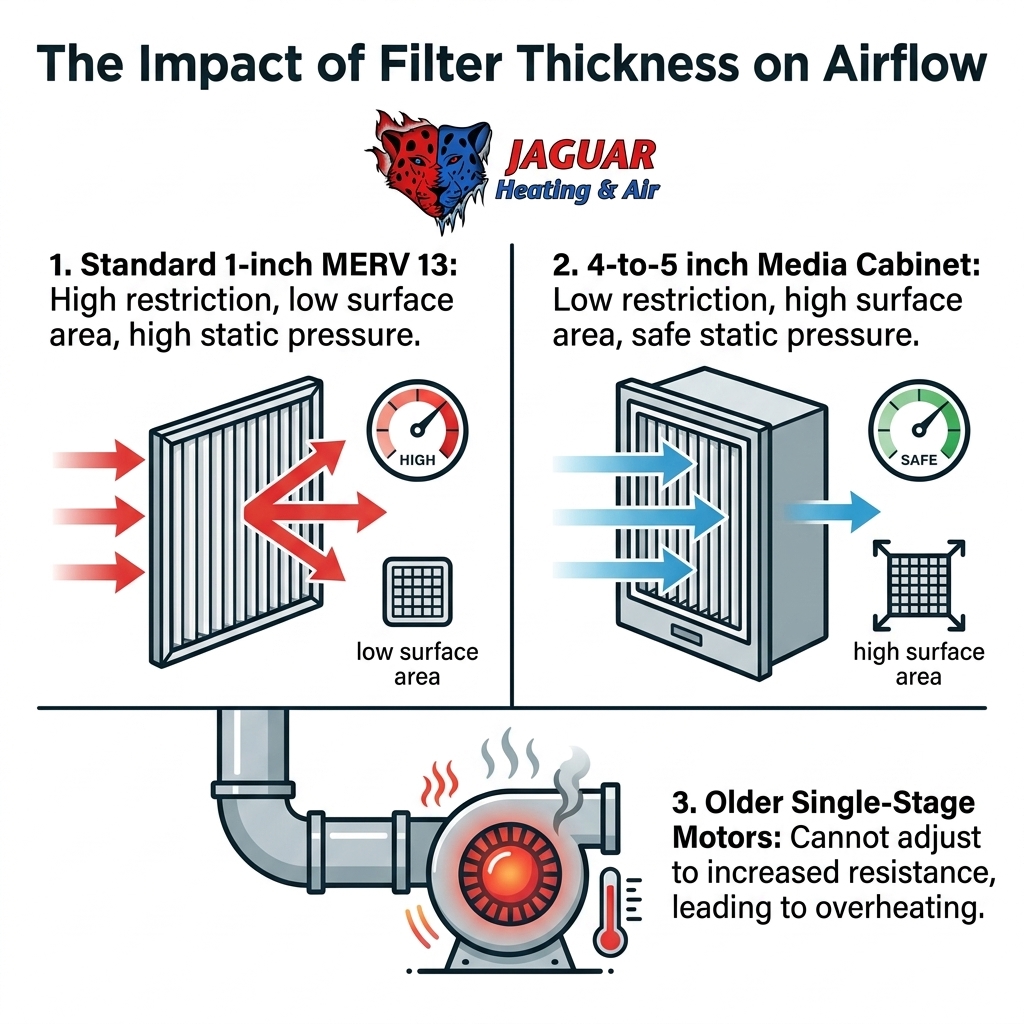
Standard 1-inch high-MERV filters achieve their high capture rates by packing microscopic fibers very closely together. While this leaves very little room for dust and smoke to pass through, it also leaves very little room for the air itself. Modern, high-end HVAC systems often feature variable-speed motors that can detect this increased resistance and ramp up their speed to compensate. However, older single-stage blower motors do not have this capability.
The Strain on Older Single-Stage Blower Motors
Older single-stage blower motors operate at a fixed speed. They are designed to move a specific amount of air against a specific amount of resistance. When you introduce a high-MERV 1-inch filter, the static pressure spikes. Because the motor cannot adjust its speed, it ends up working harder while actually moving less air. This electrical and mechanical strain causes the motor to run hotter than its design limits allow.
Over time, this continuous overheating degrades the motor's internal components. The bearings can wear out prematurely, and the electrical windings can short. When our team gets a call because a blower motor sounds like a jet engine, it is often a direct result of the system fighting against severe airflow restriction. The motor is quite literally suffocating, pulling more electricity and generating excess heat just to force a minimal amount of air through your vents.
Symptoms of a Choking HVAC System
When an HVAC system is suffocating due to a restrictive filter, it will usually give you several warning signs before a total breakdown occurs. Recognizing these symptoms early can save you from costly emergency repairs.
Just recently, our team at Jaguar Heating & Air answered a call from a Sacramento homeowner late on a Friday night during an early September heat spike because their blower fan simply would not turn on. They had recently installed a premium, 1-inch high-MERV filter to combat outdoor air issues. One of our technicians arrived the following morning and quickly identified that the severe airflow restriction had caused the older single-stage blower motor to overheat and trip its internal safety switch. Once the issue was fixed and a proper filter was installed, the AC blower fan was repaired quickly and the system returned to safe operation.
Warning Signs to Watch For
• A strained or overheating blower motor: The motor may struggle to turn on, run unusually hot, or shut off completely before the thermostat reaches its target temperature.
• Frozen evaporator coils: During Sacramento's early fall heat transitions, restricted airflow means not enough warm indoor air is blowing over the cold indoor coil. The coil temperature drops below freezing, turning normal condensation into a solid block of ice.
• Tripped limit switches: During the heating season, a lack of airflow causes the furnace's heat exchanger to overheat. A safety device called a high-limit switch will shut the furnace down to prevent a fire hazard.
• Weak airflow at the vents: You may notice that the air barely trickles out of your registers, leaving some rooms uncomfortably warm or cold despite the system running constantly.
• Unusual noises: Whistling sounds at the return grille or a loud humming from the blower cabinet usually indicate that the system is pulling air through a heavily restricted space.
If you experience any of these symptoms shortly after upgrading your filter, you may need professional AC repair to undo the damage and restore proper airflow.
Comparing Filtration Options: 1-Inch MERV vs. Media Cabinets
If standard 1-inch high-MERV filters are dangerous for older systems, how do you protect your home's air during smoke events? The answer lies in surface area. A filter's ability to clean the air without restricting flow depends entirely on how much filter media is exposed to the air stream.
The Geometry of Deep Pleats
A 1-inch MERV 13 filter has very little surface area. All the air must pass through a flat, dense barrier. A media cabinet, on the other hand, uses a filter that is 4 to 5 inches thick. These filters are deeply pleated, like an accordion. If you were to pull the pleats flat, a 5-inch media filter might contain 20 to 30 square feet of actual filter material, compared to just 2 or 3 square feet in a standard 1-inch filter.
This massive increase in surface area allows a media filter to achieve a high MERV rating (capturing tiny smoke particles) while maintaining very low static pressure. The air has dozens of square feet to pass through, moving slowly and easily across the media without straining the blower motor.
Filtration Strategies Side-by-Side
• 1-Inch High-MERV (13+) — Airflow Restriction: Very High (Dangerous for older units) — Surface Area: Low (~2-3 sq. ft.) — Best For...: Modern variable-speed systems only.
• 4-to-5 Inch Media Cabinet — Airflow Restriction: Low to Moderate (Safe) — Surface Area: Very High (~20-30 sq. ft.) — Best For...: Whole-home purification without motor strain.
• 1-Inch MERV 8 + Room Purifiers — Airflow Restriction: Low (Safe) — Surface Area: Moderate (Combined) — Best For...: Protecting older ductwork while treating specific rooms.
Upgrading to a media cabinet requires professional modification of the sheet metal ductwork next to your furnace or air handler. It is not a DIY project, but it offers the safest long-term solution for homes in the Sacramento region. Alternatively, sticking with a standard MERV 8 filter to protect the equipment, while using localized HEPA room purifiers during heavy smoke, is an excellent compromise. Discussing these options with our Jaguar Heating & Air technicians during your routine HVAC maintenance visit can help you make an informed decision.
Why Professional Airflow Testing Matters
Guessing which filter your specific system can handle often leads to expensive repairs and a shortened equipment lifespan. Every home's ductwork is unique, meaning the static pressure in your home will be completely different from your neighbor's, even if you have the exact same furnace model.
The Professional Assessment Process
Balancing indoor air quality desires with existing equipment capabilities requires localized, mechanical knowledge. Our expert technicians at Jaguar Heating & Air understand the specific airflow requirements of older Sacramento homes and can physically measure static pressure to recommend safe upgrades. Here is how our professionals approach the problem:
1. Measuring Total External Static Pressure (TESP): Technicians use a highly sensitive digital tool called a manometer to measure the air pressure on both the supply and return sides of the system. This provides a baseline reading of how hard the older single-stage blower motor is currently working.
2. Evaluating Ductwork Capacity: The technician inspects the size and layout of the return drops and supply trunks. Undersized ductwork combined with a restrictive filter is a recipe for disaster.
3. Testing Filter Pressure Drops: By measuring the pressure before and after the filter slot, professionals can determine exactly how much resistance the current filter is adding to the system.
4. Recommending Safe Upgrades: Based on the hard data, the technician will reveal whether the ductwork and blower can support a media cabinet upgrade, or if a lower MERV rating paired with standalone purifiers is the safer route.
Relying on physical measurements rather than guesswork ensures that your pursuit of clean air doesn't end up destroying your heating and cooling equipment.
Frequently Asked Questions About High MERV Filters
Can a high MERV filter damage my older HVAC system?
Yes, a high MERV filter can easily damage an older HVAC system. Older single-stage blower motors are designed to push air against a very specific amount of resistance. When you install a dense, restrictive filter, the motor has to work much harder, leading to overheating, increased electrical strain, and premature mechanical failure.
Why does my system freeze up with a new filter?
Your system freezes up because a highly restrictive filter severely reduces the volume of warm indoor air blowing over the cold evaporator coil. Without enough warm air to absorb the cooling energy, the coil's temperature drops below freezing. The natural condensation on the coil then turns to ice, eventually blocking airflow entirely.
What is the safest MERV rating for an older furnace?
For most older furnaces with standard 1-inch filter slots, a MERV 8 filter is generally considered the safest maximum rating. MERV 8 filters are highly effective at capturing common household dust, pollen, and pet dander without creating excessive static pressure that strains the blower motor.
Does MERV 13 restrict airflow too much?
A 1-inch MERV 13 filter almost always restricts airflow too much for older residential systems. While modern variable-speed systems can sometimes compensate for the added resistance, older systems cannot. If you want MERV 13 filtration safely, you typically need to upgrade to a 4-to-5 inch deep-pleated media cabinet.
How often should I change my filter during wildfire season?
During September fall prep and heavy wildfire season, you should check your filter every two to three weeks. Heavy smoke and ash can clog a standard filter much faster than normal household dust. If the filter looks noticeably grey or black, it should be replaced immediately to prevent airflow restriction.
Find the Right Balance for Your Home's Air
Protecting your family from poor outdoor air shouldn't mean sacrificing your HVAC system. There are safe, effective ways to achieve exceptional indoor air quality without straining older equipment. Whether it's upgrading to a high-capacity media cabinet or finding the perfect filter rating for your current setup, we'll help you weigh your options. By understanding how high MERV filters can choke your older HVAC system, our team at Jaguar Heating & Air can help you find the perfect filtration balance for your specific Sacramento region home.
Recent Posts

Troubleshooting HVAC Maintenance: Why Your Heater Smells Like Burning on Startup
Why we check the exact odor on fall startups. Use our home maintenance tips and troubleshooting criteria to safely tell harmless dust from a real fire hazard.
Fall Home Maintenance Tips and Troubleshooting
Smelling burning dust during your first fall heating cycle? See what is normal versus a safety risk with our home maintenance tips and troubleshooting.

Navigating the October Heating Startup: A Guide to Fall HVAC Maintenance
Is your first fall heating startup causing strange odors? Rely on our local service expertise and area tips to know when to call a pro on this in Sacramento.