.avif)
How to Tell If Your AC Contactor is Pitted and Failing
After thousands of high-load cycles this summer, your AC's electrical components are exhausted. Catching a failing contactor early prevents a catastrophic compressor breakdown this fall.
After thousands of high-load cycles this summer, your AC's electrical components are exhausted. Catching a failing contactor early prevents a catastrophic compressor breakdown this fall.

The Hidden Toll of Summer on Your Air Conditioner's Electrical System
As the intense heat finally breaks and we enter the September post-summer transition, knowing how to tell if your AC contactor is pitted and failing is a critical piece of homeowner knowledge. By early fall, your cooling system has already run a grueling marathon. It has cycled on and off thousands of times to keep your home comfortable, and our technicians know firsthand that this heavy workload leaves hidden wear and tear on the internal components.
One of the most vulnerable parts of your system is the AC contactor. This heavy-duty electrical switch takes the brunt of the electrical fatigue every time your thermostat calls for cold air. After thousands of high-load cycles, the metal components inside this switch become vulnerable to pitting, charring, and degradation. Recognizing these subtle signs of electrical wear early on prevents a minor repair from turning into a catastrophic system failure.
Whether you need comprehensive air conditioning services or targeted AC repair in Sacramento, our team at Jaguar Heating & Air has seen time and again that catching electrical fatigue before the system shuts down is the smartest move you can make for your home.
What Is an AC Contactor and Why Does It Pit?
To understand why this specific component fails, you have to understand the massive amount of energy required to cool a house. A standard light switch in your hallway handles a tiny amount of electricity. The AC contactor, however, is tasked with managing the heavy, high-voltage power needed to run your outdoor condenser.
During the peak of the cooling season, the Sacramento Valley's triple-digit summer heat causes your air conditioner to cycle on and off constantly. This hyper-frequent cycling exponentially accelerates the natural degradation process inside the electrical panel by the time early fall arrives. In fact, our team frequently fields calls during early September heat spikes when a house stops cooling entirely. When our technicians arrive, we often find a heavily pitted contactor stopping voltage to the compressor, and we work with the homeowner to explain the available options to get the house cooling effectively again.
The Role of the High-Voltage Switch
The gatekeeper of power: The contactor acts as the primary gatekeeper for your system's most power-hungry components. When your thermostat detects that the house is too warm, it sends a low-voltage signal to the outdoor unit. This small signal activates a magnetic coil inside the contactor. The magnet pulls a set of heavy metal contacts together, closing the circuit and allowing high voltage (typically 240 volts) to flow directly into the compressor and the condenser fan.
Because it handles such massive electrical loads, the contactor is built tough. However, no mechanical switch can withstand the physics of high-voltage electricity forever without showing signs of wear.
The Mechanics of Electrical Arcing
The spark of connection: Every single time those heavy metal contacts pull together to start your air conditioner, a small electrical arc occurs. Think of it as a microscopic lightning bolt jumping between the two pieces of metal just before they physically touch.
This natural arcing generates extreme, localized heat. Over thousands of cycles, that heat slowly vaporizes tiny amounts of the metal surface. This process leaves behind small craters, carbon buildup, and rough patches on the once-smooth metal. This erosion is what HVAC professionals call "pitting." As the pitting gets worse, the electrical connection becomes weaker, forcing the system to work much harder to pull the necessary voltage across the damaged gap.
Auditory Warning Signs: Listening for Electrical Fatigue
You do not need to be an electrician to notice when your cooling system is struggling. Often, the earliest warning signs of a failing contactor are auditory. By simply listening to your outdoor unit when it starts up, you can catch electrical fatigue before it causes permanent damage.
Under normal conditions, a healthy contactor makes a very distinct, solid "clack" or "click" sound when it engages. It is a single, decisive noise followed immediately by the smooth hum of the compressor and fan turning on. If the metal contacts are heavily pitted, that clean connection is lost, and the sounds change dramatically.
• Normal Operation — What You Hear: A single, solid "click" when the cycle starts. — What It Means for Your System: The electrical connection is clean, solid, and functioning as intended.
• Early Pitting — What You Hear: A loud, continuous hum or intense electrical buzzing. — What It Means for Your System: Voltage is struggling to jump across damaged, carbon-coated metal contacts.
• Severe Failure — What You Hear: Rapid chattering, like a machine gun or fast clicking. — What It Means for Your System: The magnetic coil is failing or the connection is highly unstable.
Loud Humming and Buzzing
The sound of resistance: If you hear a loud humming or an intense electrical buzz coming from the outdoor cabinet, pay attention. This noise usually indicates electrical resistance. Because the pitted metal surfaces no longer sit flush against each other, the voltage has to fight to cross the gap. This struggle creates a vibration that you hear as a loud buzz. It is often the earliest audible sign of severe pitting, signaling that you should look into replacing your contactor before it welds shut.
Rapid Chattering Noises
The machine-gun effect: A chattering noise sounds like rapid, continuous clicking. This occurs when the contactor rapidly bounces open and closed. It usually means the electrical connection is highly unstable, or the magnetic coil that pulls the contacts together is failing. If you hear this rapid chattering, turn off your air conditioner at the thermostat immediately to prevent catastrophic electrical damage to the rest of the unit.
Visual and Operational Symptoms You Can Safely Observe
While listening to your unit provides great clues, watching how the system operates offers even more evidence. It is crucial to remember that you should never open the electrical panel or attempt to use multimeters on your outdoor unit. The 240V electricity inside is incredibly dangerous. However, you can safely observe several operational symptoms from a distance.
For example, when our Jaguar Heating & Air technicians responded to a no-cool call at a local Sacramento rental property on a hot Friday afternoon, the system simply refused to start. We arrived, diagnosed a severely pitted contactor within ten minutes, and provided a clear explanation of the repair process and the preventive maintenance needed to avoid future breakdowns.
1. The indoor blower runs, but the outside condenser unit fails to start. This is one of the most common operational signs of a blocked electrical path.
2. The system refuses to shut off even when the thermostat temperature is reached. This points to a dangerous situation where the switch is physically stuck in the "on" position.
3. You notice faint smells of burning plastic or ozone near the outdoor unit. This indicates melting insulation or severe electrical arcing inside the cabinet.
The Condenser Refuses to Start
The broken bridge: You might notice that your indoor vents are blowing air, but the air is completely room-temperature. When you walk outside, the outdoor condenser unit is completely silent. In this scenario, the thermostat is successfully calling for cooling, and the indoor fan turns on, but the high voltage is being stopped dead at the pitted contactor. The electrical bridge is too damaged to let the power through, leaving your compressor starved of electricity.
The System Won't Shut Down
The endless cycle: On the opposite end of the spectrum, you might realize your air conditioner has been running for hours and refuses to turn off. Even if you set the thermostat higher or turn it off completely, the outdoor unit just keeps roaring. This is a major warning sign. It usually means the intense heat of the electrical arcing has literally melted the metal contacts together, fusing them in a permanent "on" position.
Burning Odors
The smell of danger: If you walk past your outdoor unit and catch a faint whiff of burning plastic, melting rubber, or that distinct, sharp "ozone" smell of an electrical spark, take action immediately. Severe pitting creates massive amounts of excess heat, which can begin to melt the plastic casing around the contactor or the insulation on nearby wires. If you smell burning, shut down the system directly from your circuit breaker.
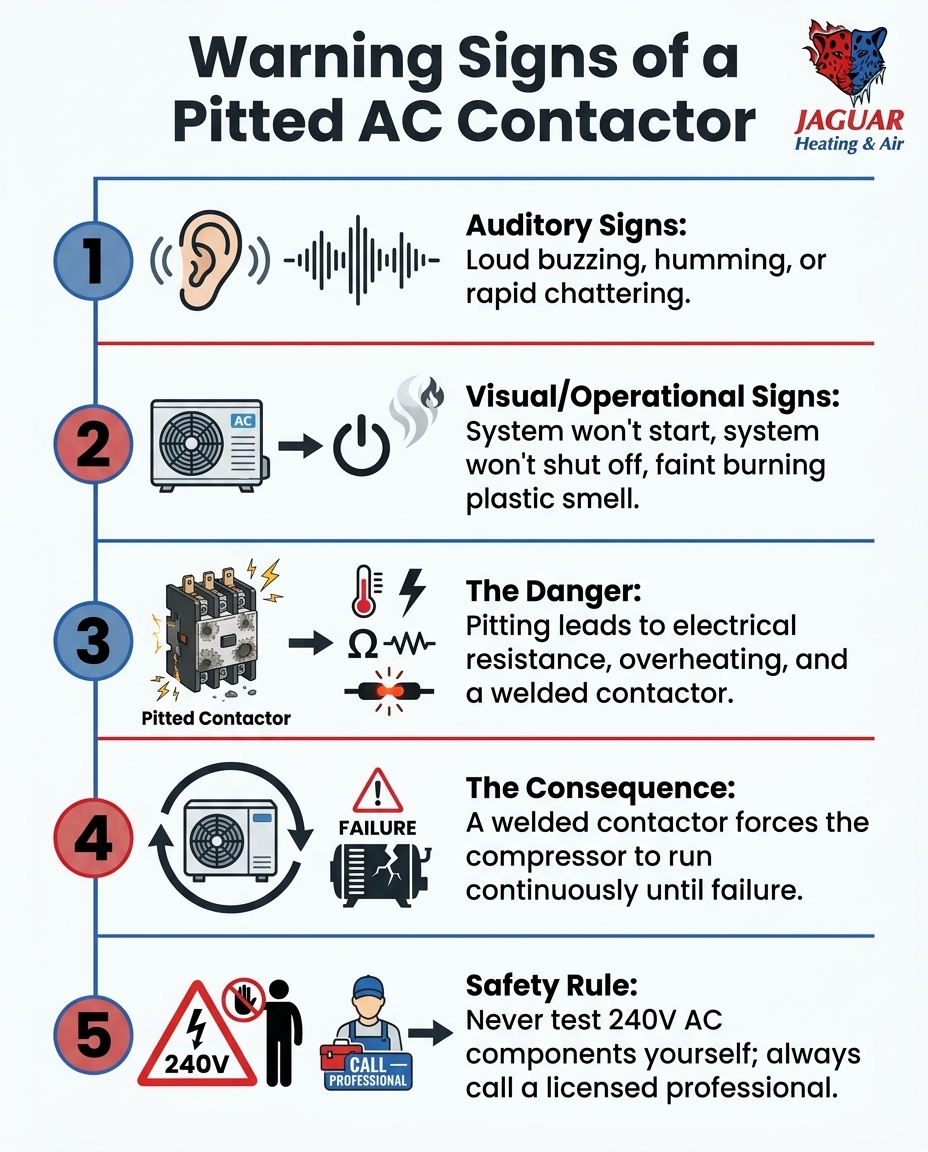
The Chain Reaction: How a Pitted Contactor Threatens Your Compressor
Ignoring a pitted contactor is never a good idea. What starts as a minor electrical inefficiency quickly escalates into a chain reaction that threatens the most expensive component in your entire cooling system: the compressor. In our years of servicing HVAC systems across Sacramento, understanding this chain reaction highlights exactly why early intervention is so important.
When you schedule routine AC maintenance with us, a technician specifically checks the contactor to stop this exact chain reaction before it starts.
From Pitting to Welding
The breaking point: As the pitting on the metal contacts deepens, the electrical resistance increases. High resistance always equals high heat. Eventually, the metal gets so hot during an electrical cycle that it briefly liquefies. When the cycle ends and the contacts try to pull apart, the molten metal cools and hardens instantly. The contacts are now welded shut. The switch that is supposed to control the flow of electricity is now permanently locked open, allowing a continuous, unstoppable flow of 240V power to the compressor.
Protecting the Compressor
The heart of the system: Your compressor is the heart of the air conditioner. It pumps the refrigerant through the lines to remove heat from your home. Compressors are incredibly durable, but they are designed to cycle on and off, giving them time to cool down between runs.
When a contactor welds shut, it forces the compressor to run continuously without a break. It will run until it overheats, burns out its internal windings, and dies completely. Replacing a contactor is a minor, straightforward fix. Replacing a burnt-out compressor is one of the most expensive HVAC repairs possible, often leading homeowners to replace the entire outdoor unit.
Why High-Voltage AC Diagnostics Require Professional Expertise
It is easy to find online tutorials suggesting that homeowners can test their own contactors using a multimeter. We strongly advise against this, as these tutorials are incredibly dangerous. The 240V electrical systems found in AC condensers carry enough amperage to cause severe shock, deep electrical burns, or even death. A simple slip of a testing probe can create a massive short circuit.
The professional diagnostic process: A licensed professional approaches high-voltage diagnostics with strict safety protocols. First, our technicians safely discharge the dual-run capacitors, which can hold a lethal electrical charge even after the main power is turned off at the breaker. Next, we measure voltage drops across the switch safely and inspect the integrity of the magnetic coil to ensure the entire assembly is functioning correctly.
Our team at Jaguar Heating & Air prioritizes homeowner safety with trusted, high-voltage local diagnostics rather than risky DIY workarounds. We can quickly and safely replace a pitted contactor with the correct OEM or compatible part, ensuring your system is grounded, secure, and ready to operate efficiently.
Safeguard Your System Before the Next Season
Catching electrical wear and tear early is the easiest way to extend the lifespan of your cooling system. By paying attention to the auditory warning signs like loud buzzing or rapid chattering, and watching for operational failures, you can save your compressor from a premature death.
If you suspect your system is struggling after a long summer of heavy use, scheduling a professional inspection is the safest path forward. An expert can evaluate the electrical components, replace worn switches, and give you the confidence that your system will operate safely and reliably. Knowing how to tell if your AC contactor is pitted and failing gives you the power to act before a minor electrical hiccup turns into a major headache.
Frequently Asked Questions
What does a failing AC contactor sound like?
A failing AC contactor typically produces a loud, continuous humming or intense buzzing sound. This noise happens because the electrical voltage is struggling to jump across damaged, pitted metal contacts. In more severe cases, you might hear a rapid chattering or machine-gun-like clicking, which indicates the connection is highly unstable and the system should be shut off immediately.
Why do AC contactors get pitted?
AC contactors get pitted due to the natural electrical arcing that occurs every time the switch engages. Because the contactor handles high voltage, a small electrical spark jumps between the metal contacts just before they touch. Over thousands of cycles, the intense heat from this spark vaporizes microscopic amounts of metal, leaving behind rough, carbon-coated craters known as pitting.
Can a bad contactor ruin a compressor?
Yes, a bad contactor can absolutely ruin a compressor if it is left unchecked. When a contactor becomes severely pitted, the excess heat can cause the metal contacts to melt and weld shut. A welded contactor forces the compressor to run continuously without any breaks to cool down, eventually causing it to overheat and fail completely.
Will an AC run with a bad contactor?
An AC might temporarily run with a slightly pitted contactor, but its performance will be highly unreliable. If the contactor is heavily pitted, the outdoor condenser may refuse to start at all, even while the indoor blower continues to push warm air. If the contactor has welded shut, the AC will run endlessly and refuse to turn off.
Is it safe to test an AC contactor myself?
No, it is never safe to test an AC contactor yourself unless you are a licensed professional. The contactor manages 240 volts of electricity, which is enough to cause severe injury or death if mishandled. Additionally, the nearby capacitors store lethal electrical charges even when the system's power is turned off, requiring specialized knowledge to safely discharge them.
How long does an AC contactor typically last?
An AC contactor typically lasts anywhere from five to ten years, depending on how frequently the system cycles on and off. In regions with extremely hot summers, the heavy workload and constant cycling can cause the contactor to degrade and require replacement much sooner. Regular professional maintenance helps track this wear and tear before the component fails.
Recent Posts
Why We Recommend Surge Protectors for Your HVAC Equipment
A standard circuit breaker isn't enough to protect modern heating and cooling systems from grid spikes. Find out how a dedicated safeguard prevents catastrophic control board failures.
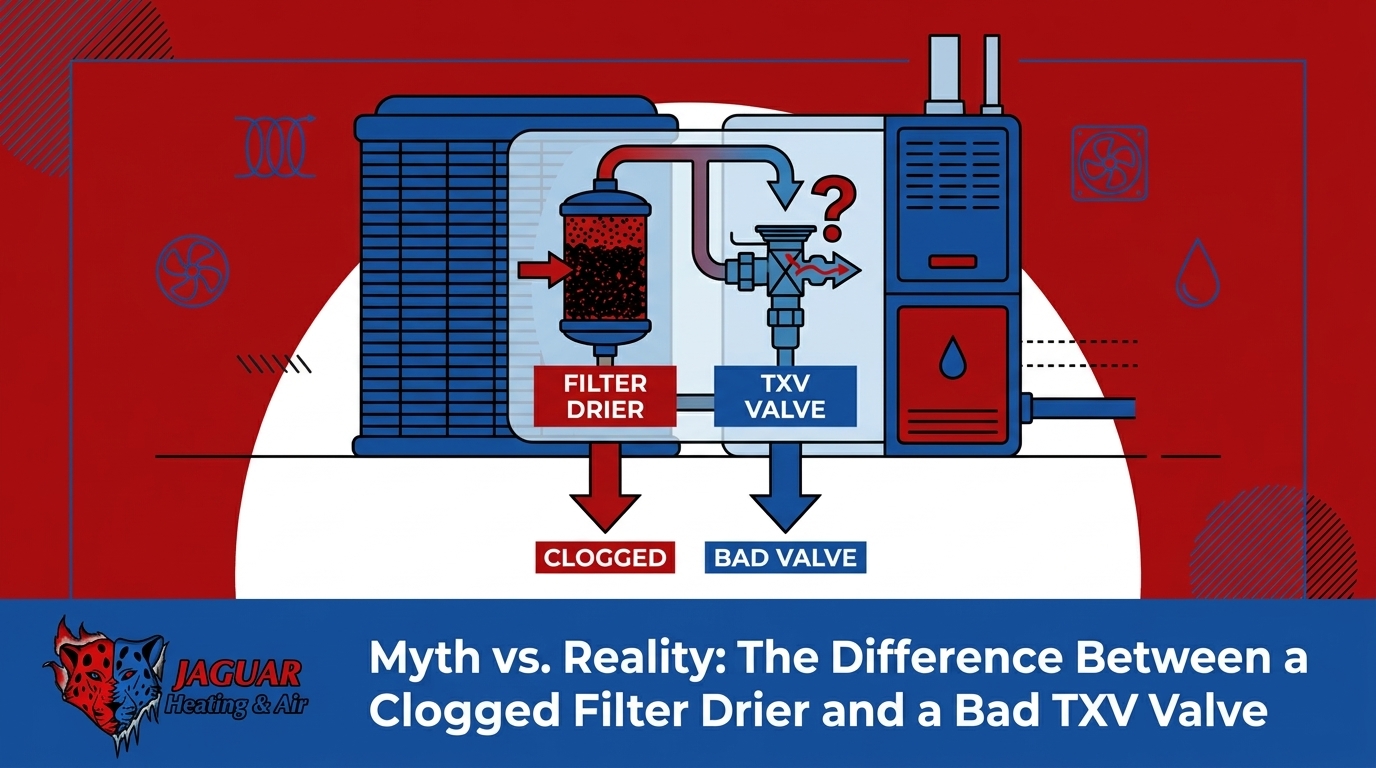
The Difference Between a Clogged Filter Drier and a Bad TXV Valve
An AC that blows warm air isn't always leaking refrigerant—it might be suffering from a flow restriction. Find out how technicians trace the bottleneck to restore your cooling.

How Sacramento's Hard Water Affects Your Evaporative Cooler Pads
By September, Sacramento's heavy mineral content often turns swamp cooler pads into rock-hard blocks. See why airflow drops drastically and weigh your end-of-season options.