.avif)
Why We Advise Against DIY Capacitor Replacements
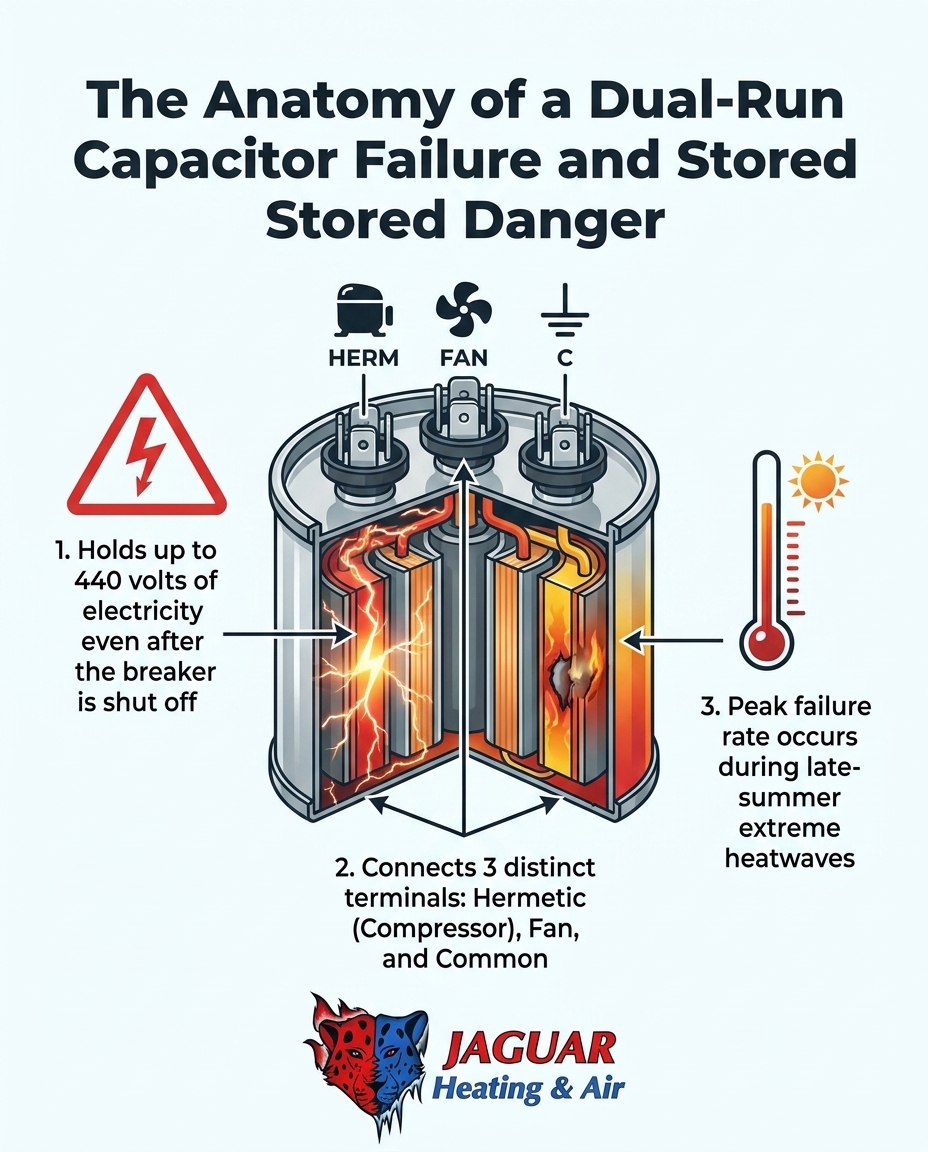
Flipping the breaker doesn't make your AC safe to touch. Even when powered down, the capacitor stores up to 440 volts of lethal energy that can cause severe injury or destroy your compressor.
Flipping the breaker doesn't make your AC safe to touch. Even when powered down, the capacitor stores up to 440 volts of lethal energy that can cause severe injury or destroy your compressor.

The Late-Summer Breakdown: When Your AC Quits in the Heat
In our years serving Sacramento homeowners, we've seen this exact scenario countless times: Your thermostat is set to 72 degrees, but the air coming from the vents is lukewarm, and the outdoor condenser has gone completely silent. This is the exact moment many homeowners start searching online for a quick fix, which is exactly why we advise against DIY capacitor replacements. When your system fails during the peak of August late-summer cooling wear, right as families are managing the busy back-to-school transition, the frustration is immediate. The house is heating up rapidly, and the temptation to take matters into your own hands is strong. You might watch a quick internet tutorial, walk out to the condenser panel, and think that simply flipping the breaker makes the unit safe to touch. But our technicians know firsthand that this assumption carries hidden, lethal risks that internet videos rarely emphasize.
If you need help right now, learn more about our Air Conditioning Services.
When an air conditioning system fails, the instinct is often to panic about the potential wait time for a professional technician. However, professional help is often much faster and more efficient than attempting a dangerous repair yourself. For example, a local homeowner reached out to our Jaguar Heating & Air team recently when their cooling dropped out during a late-summer heatwave. Our technician arrived within a small window, called before arrival, and safely fixed the problem in under 30 minutes for a straightforward, competitive rate. That level of speed and efficiency proves that taking dangerous electrical matters into your own hands simply isn't necessary. The reality is that the outdoor condenser is a high-voltage environment, and treating it like a basic household appliance is a recipe for disaster. Before you pick up a screwdriver, you need to understand exactly what you are dealing with inside that metal cabinet.
The Illusion of the Flipped Breaker: Understanding Stored Voltage
The core problem: Our field team frequently discovers that most homeowners believe shutting off the power at the main electrical panel neutralizes all danger inside an HVAC unit. While this is true for a standard light fixture or a ceiling fan, it is dangerously incorrect when dealing with an air conditioning condenser. The component responsible for jump-starting your compressor and fan motors—the dual-run capacitor—operates under entirely different rules.
The mechanical cause: A capacitor is not just a wire or a switch; it is a high-voltage energy storage device. Think of it as a massive, heavy-duty battery designed to deliver a massive jolt of electricity in a fraction of a second. Air conditioning compressors require a tremendous amount of torque to start spinning, far more than standard household wiring can provide instantly. The capacitor stores energy while the system is running and holds it in reserve to provide that necessary kick the next time the thermostat calls for cooling.
The professional solution: Because capacitors act like deep-storage batteries, they retain their electrical charge long after the main power is disconnected. Touching the wrong terminals on a fully charged capacitor can release up to 440 volts of stored charge instantaneously. Standard household tools, like a basic screwdriver with a plastic handle, do not provide adequate insulation against this level of voltage. This is why our professional technicians treat these components with extreme caution, utilizing specialized equipment to neutralize the threat before ever attempting a removal.
Why the Disconnect Box Isn't Enough
The outdoor disconnect box mounted on the side of your house is designed to stop new electricity from entering the condenser unit. It acts as a safety gate. However, closing that gate does absolutely nothing to drain the electricity that is already trapped inside the capacitor.
• Energy Flow — Standard 120V Household Wiring: Continuous flow from the breaker panel — HVAC Dual-Run Capacitor: Stores energy internally like a battery
• Safety Mechanism — Standard 120V Household Wiring: Flipping the breaker stops the flow immediately — HVAC Dual-Run Capacitor: Retains up to 440 volts after breaker is off
• Lethal Risk — Standard 120V Household Wiring: Moderate (standard shock hazard) — HVAC Dual-Run Capacitor: Extreme (instantaneous high-voltage discharge)
• Tool Requirement — Standard 120V Household Wiring: Standard insulated hand tools — HVAC Dual-Run Capacitor: High-voltage rated diagnostic and discharge tools
Contrasting standard 120V household wiring with the extreme stored energy in HVAC components highlights exactly why DIY repairs are so dangerous. The disconnect box protects you from the city's power grid, but it does not protect you from the concentrated energy waiting inside the capacitor.
Why Capacitors Fail Under Extreme Thermal Stress
To understand why capacitors blow out so frequently, you have to look at the environment they operate in. Continuous high-load operation degrades the internal components of a capacitor over time. Inside the metal casing, a capacitor contains layers of conductive film and a dielectric fluid designed to manage heat and electrical flow. When the system runs constantly, that internal fluid heats up.
We see the effects of this firsthand every August. With summer temperatures regularly exceeding 100 degrees in Sacramento, the extreme ambient temperature compounds the internal heat generated by the condenser. The outdoor unit sits in the blazing sun, pulling in hot air to try and cool the refrigerant, while the electrical components bake inside the metal cabinet. This intense thermal stress pushes aging capacitors past their breaking point. Heat fatigue is cumulative, meaning the damage builds up slowly over months of operation, often resulting in sudden, catastrophic failures right at the end of the cooling season.
Physical signs of a blown capacitor include:
• A bulging or domed top: When the internal fluid boils and expands, it pushes the top of the metal casing upward, creating a visible mushroom effect.
• Leaking dielectric fluid: Extreme pressure can cause the casing to rupture, leaking an oily substance onto the bottom of the electrical panel.
• Heavy rust or corrosion: While not a direct sign of a blowout, severe corrosion on the terminals indicates moisture intrusion and impending failure.
• A burnt electrical smell: An acrid, melting plastic odor coming from the access panel often accompanies a failed capacitor.
Because these blowouts happen so frequently when homeowners are most desperate for cooling, the temptation to rush a DIY fix is high. But understanding the physical breakdown of the part should reinforce why our team insists it requires careful, professional handling.
The Threat of Catastrophic Compressor Damage
The core problem: Beyond the immediate personal safety risks of electrocution, attempting a DIY capacitor swap carries severe financial and mechanical risks. A dual-run capacitor is not a simple two-wire component. It features three distinct terminals, each serving a highly specific function.
The mechanical cause: The three terminals on a dual-run capacitor are marked as Hermetic (HERM), Fan (FAN), and Common (C). The Hermetic terminal sends power to the compressor, the Fan terminal powers the outdoor fan motor, and the Common terminal completes the circuit. In our field experience, we've noticed that internet tutorials often gloss over the specific wiring configurations required for different AC models, making it look like a simple matter of moving wires from the old part to the new one. However, wire colors are not universal, and placing the wrong wire on the wrong terminal is incredibly easy for an untrained individual to do.
The professional solution: If you wire a dual-run capacitor incorrectly, the results are immediate and devastating. Sending the wrong voltage to the compressor forces the motor to attempt to run on an incorrect microfarad rating. This can cause the compressor to lock up, melting the internal winding insulation and resulting in irreversible burnout. What could have been a minor inconvenience is suddenly a catastrophic failure. If your system is down, it is always safer to rely on emergency HVAC service rather than risking the heart of your cooling system.
The Cost of a Simple Wiring Mistake
When we are called out to fix a botched DIY job, swapping the hermetic and fan wires is one of the most common mistakes we see. Because the fan requires a much lower microfarad rating than the compressor, crossing these wires starves the compressor of the energy it needs to start, while simultaneously overloading the fan motor. The compressor will pull excessive locked rotor amps, overheat in seconds, and fail.
It is vital to emphasize that compressor failure requires a massive, invasive system repair. The compressor is the most expensive component in your entire HVAC system. Risking its destruction to save a little bit of time on a DIY capacitor swap is a gamble that rarely pays off.
Professional Voltage Discharge Protocols vs. DIY Gambles
The difference between a DIY attempt and a professional repair comes down to rigorous safety protocols and specialized training. Professional HVAC technicians do not simply pull the disconnect block and start unscrewing wires. They follow strict, standardized procedures to ensure the unit is entirely neutralized before any hands enter the electrical panel.
Technicians use specialized, high-voltage insulated tools designed specifically to safely bridge terminals and bleed off the up to 440 volts of stored charge. They do not rely on standard screwdrivers or pliers, which can easily arc and cause severe burns or shock. Furthermore, professionals use calibrated multimeters to verify that the energy has been completely dissipated before proceeding.
At Jaguar Heating & Air, our professional safety training and field experience handling lethal voltages ensure that proper discharge and replacement protocols are followed every single time, without putting homeowners at risk. We verify that the new capacitor's microfarad rating matches the exact specifications of the compressor motor, ensuring optimal performance. Contrasting this rigorous field training with the trial-and-error approach of DIY attempts highlights why professional service is non-negotiable. We strongly advise against any homeowner attempting to discharge a capacitor themselves, as the margin for error is zero.
Secondary Risks: Incorrect Sizing and Voided Warranties
Even if a homeowner manages to safely navigate the stored voltage and correctly wire the terminals, there are still non-lethal but highly detrimental consequences to sourcing and installing an aftermarket capacitor yourself. The most significant of these is incorrect sizing.
Capacitors are rated in microfarads (µF), which measure their ability to store an electrical charge. A dual-run capacitor will have two ratings (e.g., 35/5 µF), one for the compressor and one for the fan. It is critical to match these exact microfarad ratings and voltage tolerances. Installing an undersized or oversized capacitor forces the motor to run hotter and work harder than it was designed to. Over time, this microscopic stress degrades the motor windings, dramatically shortening the lifespan of the equipment.
Secondary risks of DIY installation include:
• Voided Manufacturer Warranties: Almost all major HVAC manufacturers stipulate that unauthorized electrical modifications or repairs performed by unlicensed individuals will instantly void the warranty on the entire condenser unit.
• Sourcing Counterfeit Parts: Online marketplaces are flooded with cheap, counterfeit capacitors that lack proper safety venting, making them prone to exploding under the intense heat of August late-summer cooling wear.
• Missing the Root Cause: A blown capacitor is sometimes a symptom of a larger issue, such as a failing fan motor drawing too many amps. A DIY swap fixes the symptom but ignores the disease.
During our routine service calls across Sacramento, our technicians often catch weakening capacitors before they fail completely. By scheduling routine AC maintenance, technicians can measure the exact microfarad output of your capacitor and replace it safely before it leaves you stranded in the heat.
Recognizing the Warning Signs Safely
You do not need to open the electrical panel to know that your air conditioner is struggling. There are several safe, external warning signs that indicate a potential capacitor issue. By recognizing these symptoms early, you can call our team for professional help before the system suffers a complete breakdown.
Listen for a distinct humming or clicking sound: If you stand near the outdoor unit and hear a persistent electrical hum or a rhythmic clicking, but the fan blades remain completely still, the dual-run capacitor has likely failed to start the motors.
Observe the airflow: If the indoor blower is running but the AC is blowing warm ambient air instead of conditioned air, it means the outdoor compressor is not engaging.
Notice frequent short-cycling: If the system struggles to turn on, runs for only a few seconds, and shuts off repeatedly, the capacitor may be failing to provide a sustained electrical charge.
If you notice any of these signs, the safest action is to turn off the thermostat and flip the breaker to the AC unit to prevent further compressor damage while waiting for a professional. A comprehensive diagnostic is always the best approach. For instance, we recently had a customer call our dispatch team in the evening during an August heatwave because their AC was blowing warm air. An appointment was set for the next morning, where our technician performed comprehensive tests, replaced the failing capacitor, and safely restored the system's performance. The job was completed within the scheduled time for a highly competitive rate, backed by a 1-year warranty. A professional can safely determine if the issue is a capacitor, low refrigerant, or something else entirely.
Safety should always be your first priority when dealing with outdoor HVAC equipment. For more information on safe practices, read our guide on Why We Never Recommend Hose-Washing Your AC Coils Without Disconnecting Power.
Frequently Asked Questions About AC Capacitors
Is it dangerous to change an AC capacitor?
Yes, it is extremely dangerous due to the high levels of stored electrical energy. Even after the main power is shut off at the breaker, a capacitor can hold up to 440 volts of stored charge. Touching the wrong terminals without professional insulated tools can result in a severe, potentially lethal electrical shock.
Can I replace an AC capacitor myself?
At Jaguar Heating & Air, we strongly advise against attempting to replace an AC capacitor yourself. Beyond the immediate risk of electrocution, miswiring the terminals can send the wrong voltage to your compressor, causing irreversible and catastrophic mechanical damage to your entire HVAC system.
How long does an AC capacitor hold a charge?
An AC capacitor can hold a lethal electrical charge for days or even weeks after the power has been disconnected. It does not automatically drain its energy simply because the breaker is flipped. Professional technicians must manually and safely discharge the stored voltage using specialized equipment before handling the component.
Do I need to turn off power to change a capacitor?
While turning off the power at the breaker and the disconnect box is the mandatory first step for any HVAC repair, it is not enough to make the unit safe. The capacitor itself acts as a battery and remains fully charged until it is manually neutralized by a trained professional.
What happens if you wire a dual-run capacitor incorrectly?
Wiring a dual-run capacitor incorrectly usually involves mixing up the hermetic and fan terminals. This sends the incorrect microfarad rating to the compressor, causing it to lock up, overheat, and melt its internal wiring. This simple mistake instantly destroys the compressor, requiring a massive system repair.
Why do AC capacitors fail more frequently during late summer?
Capacitors fail more frequently during late summer due to cumulative heat fatigue and extreme thermal stress. Months of continuous high-load operation during heatwaves cause the internal dielectric fluid to degrade and expand, eventually causing the casing to bulge or rupture right when you need cooling the most.
Prioritize Your Safety and Protect Your AC System
When your air conditioner fails during intense August late-summer cooling wear, the desire for a fast solution is completely understandable. However, our team wants you to know that the risk of severe electrical shock and catastrophic compressor damage far outweighs the perceived convenience of a DIY fix. The hidden danger of up to 440 volts of stored charge is a reality that internet tutorials simply cannot prepare you for.
As Sacramento's trusted local experts, we encourage you to prioritize your physical safety and the long-term longevity of your HVAC equipment by leaving high-voltage electrical repairs to trained professionals. Don't gamble with your compressor or your well-being. If your system is showing signs of a failing capacitor, reach out for professional AC repair in Sacramento and let the experienced technicians at Jaguar Heating & Air restore your comfort safely and efficiently.
Recent Posts
HVAC Maintenance Guide: Comparing Heating Replacement Options Before Winter
Before winter hits, make sure your furnace can handle the cold. Compare your options with these objective heating options comparisons for homeowners.
HVAC Maintenance: Troubleshooting the Fall Heating Startup
Why does your furnace smell like burning on that first chilly morning? Use our home maintenance tips and troubleshooting to know when to call a pro this fall.
HVAC Maintenance: Home Maintenance Tips and Troubleshooting for Fall Heating Startup
Why some systems smell burning during fall startup, and how these home maintenance tips and troubleshooting steps help you decide when to call a professional.