.avif)
Deciding When to Stop Repairing a 15-Year-Old Air Conditioner
If your aging cooling system barely survived summer, you might wonder if another patch is worth it. We break down the sunk costs of ongoing repairs versus the reliability of a new system.
If your aging cooling system barely survived summer, you might wonder if another patch is worth it. We break down the sunk costs of ongoing repairs versus the reliability of a new system.

Is It Time to Stop Patching Your Aging Cooling System?
Are you struggling with the frustrating process of deciding when to stop repairing a 15-year-old air conditioner that barely limped through August? You are certainly not alone. Here at Jaguar Heating & Air, our team regularly speaks with Sacramento homeowners facing this exact critical turning point. As the intense summer heat finally begins to wane and we transition toward the September pre-heating season, many homeowners realize their cooling system has served them well, but recurring refrigerant leaks and strange noises are becoming impossible to ignore.
The core question is no longer just about fixing a broken part. You have to decide whether to pay for one last patch to survive the final hot weeks of the year, or to invest in a modern, warrantied system before the winter chill sets in. In our experience, looking at this choice through the lens of sunk costs versus long-term return on investment provides clarity. Getting an objective view of your home's climate control needs takes the emotion out of an otherwise stressful situation.
If you need help evaluating your Air Conditioning system, our team is ready to guide you through your AC Replacement options.
The Reality of Running a 15-Year-Old Air Conditioner in Sacramento
A cooling system ages differently depending on where it operates. Running a 15-year-old system (likely an R-22 or early R-410A unit) in a mild coastal town is completely different from relying on that same equipment here in the Central Valley. Sacramento's intense, triple-digit summer heat places maximum strain on aging air conditioners, accelerating wear and tear far beyond what homeowners in milder regions experience.
With Sacramento averaging over 20 days of 100-degree heat annually, we see firsthand how an air conditioner accumulates an immense amount of "mileage." This prolonged, extreme cooling demand degrades critical components over time. Our technicians recently helped a local family who experienced this exact breaking point. During a severe stretch of triple-digit heat, their house completely stopped cooling. One of our lead technicians arrived, thoroughly explained the underlying mechanical failure, and laid out the available options. While we were able to get their house cooling effectively again, the situation perfectly illustrates the precarious nature of relying on an older unit when the weather turns brutal.
The Cumulative Impact of Extreme Heat
When evaluating the true condition of your older system, we urge homeowners to consider how the regional climate accelerates wear across these three main areas:
1. Compressor fatigue: The compressor is the heart of your system. Pushing a 15-year-old compressor through back-to-back 100-degree days causes internal motor windings to break down and mechanical parts to lose their tight tolerances.
2. Coil degradation: Years of expanding and contracting under extreme heat cycles weaken the metal in your evaporator and condenser coils, making them highly susceptible to microscopic refrigerant leaks.
3. Electrical stress: Capacitors, contactors, and wiring endure massive thermal loads during long summer run cycles. As these parts age, they draw more electricity to perform the same amount of work, increasing the risk of sudden electrical failure.
Furthermore, these older systems often rely on phased-out refrigerants. When a breakdown happens during a heat wave, a pattern we see often is that sourcing parts and compatible refrigerant for a 15-year-old unit becomes a difficult, drawn-out process right when reliability is paramount.
Applying the 50% Rule for HVAC Repairs
Before scheduling another AC Repair, you need a reliable way to determine if the fix is actually worth the investment. The 50% rule provides a clear, objective mathematical framework to help you make that decision without relying on guesswork.
How the 50% Rule Works
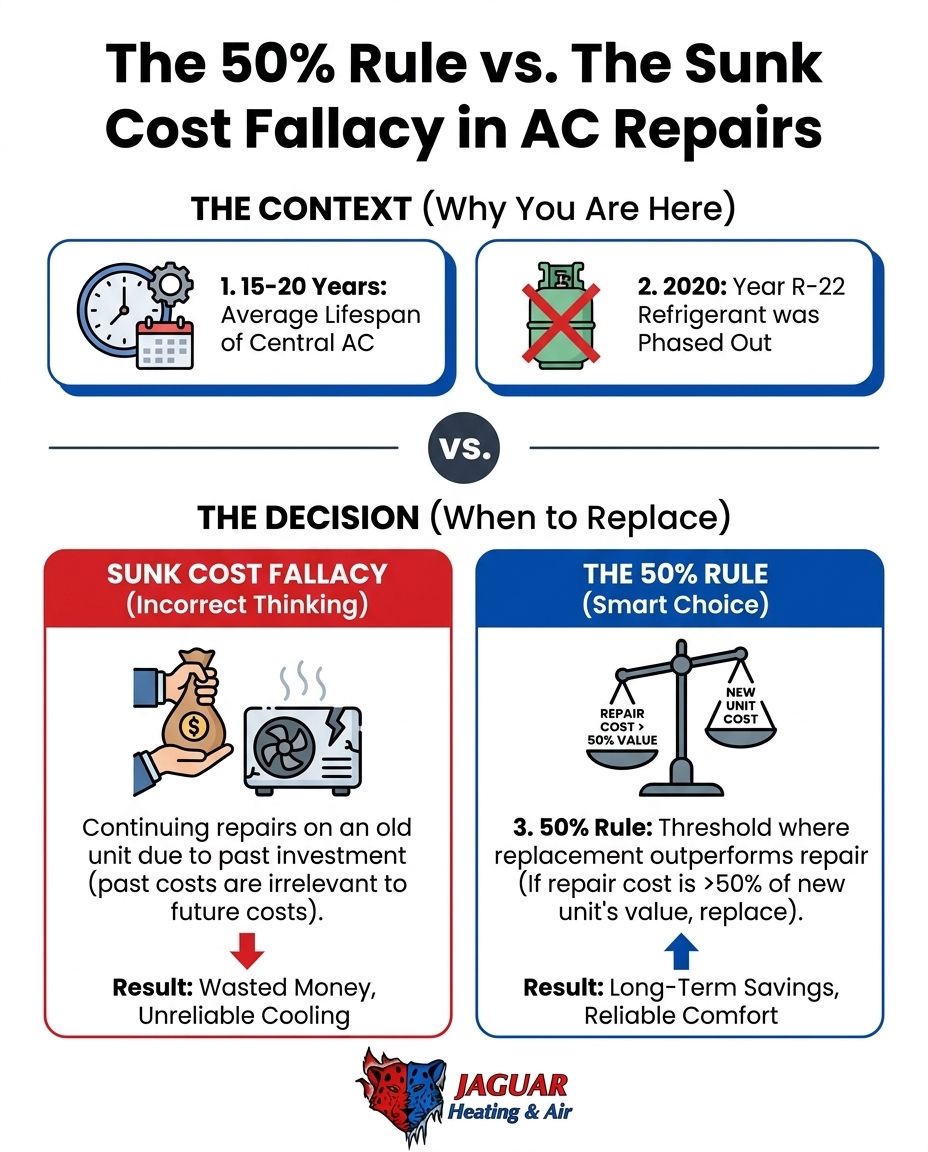
The 50% rule is a standard industry guideline used to weigh repair costs against the age and value of the equipment. To use this rule, you multiply the cost of the proposed repair by the age of the unit in years. If that resulting number exceeds half the cost of a brand-new replacement system, replacing the unit is generally the wiser financial choice.
Instead of looking at a repair quote in isolation, this rule forces you to view the repair as a percentage of a new system's value. For a 15-year-old system, the multiplier is so high that even moderate repairs often fail the 50% test. This calculation acts as a safeguard against bad investments, which is why our team at Jaguar Heating & Air frequently recommends it to our clients.
Avoiding the Sunk Cost Fallacy
Many homeowners fall into the "sunk cost fallacy." This happens when you continue pouring resources into a failing unit simply because you have already spent time and effort fixing it in the past. You might think, "I just replaced the fan motor last year, so I have to keep this thing running." However, past repairs do not guarantee future reliability.
Signs you are trapped in the sunk cost fallacy:
• Frequent service calls: You find yourself calling a technician multiple times per season for different issues.
• Diminishing returns: Each repair restores cooling for a shorter duration before the next problem arises.
• Anxiety during heat waves: You constantly worry if the system will turn on when the thermostat calls for cooling.
Breaking free from this cycle requires a transparent, honest financial assessment. Our goal as your local HVAC experts is to provide objective guidance that empowers you to make a cost-effective decision without any high-pressure sales tactics. You deserve to know exactly where your system stands so you can choose the path that makes the most sense for your home.
Sunk Costs vs. Long-Term ROI: The Refrigerant Leak Dilemma
One of the most common and frustrating issues with a 15-year-old system is a refrigerant leak. Addressing this specific problem highlights the stark difference between a temporary patch and a permanent solution.
The Problem: Dwindling Refrigerant and Lost Cooling
When your aging system develops a leak, it loses its ability to transfer heat effectively. Your home stays warm, the system runs nonstop, and your energy bills climb. Just last spring, our service team responded to a local homeowner who realized their AC was running low on Freon and needed several components replaced. They called for help and secured an appointment for the very next day. Our technician ran comprehensive tests, replaced the failing parts, recharged the system, and re-tested everything to ensure it was running smoothly. While this quick response successfully restored their cooling, continually patching an older system often raises a bigger question about long-term viability.
The Cause: The R-22 Phase-Out
The root of the dilemma goes beyond just a hole in the copper coil. The U.S. Environmental Protection Agency (EPA) officially phased out the production and importation of R-22 refrigerant in 2020. Because 15-year-old systems were designed around this legacy refrigerant, servicing a leak has become increasingly impractical. Adding refrigerant without fixing the underlying leak is a temporary, recurring sunk cost. The system will simply leak again, leaving you right back where you started.
The Solution: Shifting to Long-Term ROI
Instead of throwing resources at a leaky, obsolete coil, we recommend transitioning to a new system for immediate returns. Modern systems use environmentally friendly refrigerants and maintain their efficiency over time. This provides a measurable return on investment through lower monthly energy consumption and the elimination of seasonal top-off fees. If you are weighing these two paths, Evaluating the Cost of Patching a Coil Leak vs. Replacing the Coil is a critical next step in understanding the options we typically recommend.
Why September is the Strategic Time for HVAC Replacement
Timing plays a massive role in HVAC decisions. While most people only think about their air conditioner during the peak of summer, in our years of maintaining and replacing Sacramento HVAC systems, we've found that early fall is actually the most strategic time to evaluate and replace your equipment.
The Pre-Heating Season Transition
September marks the crucial transition from cooling season to heating season preparation. Sacramento's late-summer heatwaves in September put final, critical stress on old units right before the shift to cooler weather. Pushing an ailing AC through these last heatwaves is a massive gamble. If the blower motor or shared electrical components fail due to air conditioning strain, we often see those same parts fail to push warm air through your home when you turn on the furnace in November.
Preventing Winter Emergencies
Upgrading your system during the seasonal transition prevents emergency, rushed replacements during peak winter cold. When a system completely fails in the middle of a January freeze, homeowners often feel pressured to make rapid decisions just to restore heat to their families. By acting in September, you have the time to research your options, compare efficiency ratings, and schedule a deliberate, stress-free installation with our team.
Securing Dual-Season Reliability
A central HVAC system operates as a unified team. Replacing your aging air conditioning unit now ensures dual-season reliability. You get the immediate benefit of efficient, powerful cooling to handle the end-of-summer heat, combined with the peace of mind that the connected indoor components are fully prepped and reliable for the winter heating demands ahead.
Pros and Cons: Repairing vs. Replacing Your Aging Unit
When you are standing at the crossroads of a major home service decision, viewing the facts side-by-side helps cut through the confusion. According to data from the Department of Energy—and mirroring what we see in the field daily—a well-maintained central air conditioning unit typically lasts between 15 and 20 years. This means a 15-year-old unit is already sitting at the very end of its designed lifecycle.
Here is a direct comparison we share with customers to summarize the decision framework:
• Short-Term Impact — Repairing the 15-Year-Old Unit: Provides an immediate, localized fix to the current broken part. — Replacing with a Modern System: Requires an initial commitment and scheduling an installation day.
• Long-Term Reliability — Repairing the 15-Year-Old Unit: High risk of inevitable future breakdowns on other aging components. — Replacing with a Modern System: Provides years of stable, predictable operation without sudden failures.
• Energy Efficiency — Repairing the 15-Year-Old Unit: System continues running at degraded, 15-year-old efficiency levels. — Replacing with a Modern System: Delivers modern SEER efficiency, reducing monthly energy consumption.
• Warranty Status — Repairing the 15-Year-Old Unit: Original manufacturer warranties are long expired. You pay out of pocket. — Replacing with a Modern System: Protected by comprehensive manufacturer warranties for ultimate peace of mind.
• Refrigerant Compatibility — Repairing the 15-Year-Old Unit: Often relies on obsolete, phased-out R-22 that is difficult to source. — Replacing with a Modern System: Uses modern, environmentally friendly refrigerants that are widely available.
Ultimately, framing the comparison comes down to ongoing anxiety versus total peace of mind. Repairing an end-of-life system means you are always waiting for the next shoe to drop. Replacing the system closes the chapter on unexpected breakdowns and lets you enjoy your home in comfort.
Modern Efficiency Gains and Accessible Upgrades
It is perfectly normal to feel apprehensive about committing to a full system replacement. However, understanding the advancements in modern HVAC technology often alleviates those concerns. The systems our installation crews build today are vastly superior to the equipment installed 15 years ago.
The Evolution of SEER Standards
Seasonal Energy Efficiency Ratio (SEER) measures how efficiently an air conditioner operates over an entire season. Minimum SEER standards have significantly advanced over the last decade and a half. This means that even a baseline modern unit operates much more efficiently than your current aging system did when it was brand new. Upgrading to a new unit immediately lowers the amount of electricity required to cool your home, which pays dividends in comfort and daily operational reliability.
Incentives and Flexible Solutions
Making the leap to new technology is more accessible than many homeowners realize. Modern, high-efficiency systems often qualify for generally applicable energy rebates or federal tax credits designed to encourage energy conservation. We always advise readers to verify current programs and eligibility with their local utility provider or a tax professional to see what incentives apply to their specific upgrade.
Furthermore, flexible payment arrangements make the transition to a new, warrantied system manageable without causing upfront strain on your household budget. By exploring Financing options, you can secure the long-term reliability your home needs while maintaining comfortable, predictable monthly terms.
Frequently Asked Questions About Aging AC Systems
Is it worth repairing a 15 year old air conditioner?
Generally, no, especially if the repair is major or involves refrigerant leaks. Because central air conditioners have a designed lifespan of 15 to 20 years, a 15-year-old unit is already nearing the end of its functional life. In our experience serving Sacramento, investing heavily in repairs at this stage usually results in diminishing returns, as other aging components are likely to fail shortly after.
What is the 50 percent rule for AC repair?
The 50 percent rule is a mathematical guideline stating that if the cost of a repair multiplied by the age of the unit approaches or exceeds half the value of a new system, replacement is the more sound investment. This framework helps homeowners avoid the sunk cost fallacy of pouring resources into obsolete equipment. It provides a clear, objective way to evaluate service quotes.
Should I replace my 15 year old AC before it breaks?
Yes, proactive replacement prevents emergency breakdowns during extreme weather. Upgrading before total failure allows you to transition smoothly, giving you time to research options and schedule installation on your terms. Doing this before the heating season begins ensures your shared blower components are reliable for winter.
How long does an AC unit usually last?
According to the Department of Energy, a well-maintained central air conditioner typically lasts between 15 and 20 years. Variables such as regional climate, frequency of maintenance, and run times heavily influence this lifespan. In regions with intense summer heat like ours, systems often skew toward the 15-year mark due to heavy component strain.
Why are R-22 refrigerant leaks so problematic?
R-22 was officially phased out in 2020 by the EPA due to its environmental impact. This phase-out means it is increasingly difficult and highly impractical to source for older, leaking systems. Fixing an R-22 leak often requires costly retrofits or constant, unsustainable top-offs that do not solve the underlying mechanical degradation.
Secure Your Home's Comfort Before Winter Arrives
Trading the sunk costs of ongoing repairs for the long-term ROI and warranty protection of a new system brings ultimate peace of mind. You no longer have to cross your fingers every time the thermostat clicks on, hoping your 15-year-old unit survives another afternoon.
As we navigate the September pre-heating season transition, our team at Jaguar Heating & Air believes now is the ideal time to take action. Securing a modern, highly efficient cooling and heating system before winter demands begin ensures your family stays comfortable year-round. Do not wait for the next major breakdown to force your hand. Reach out today to schedule a comprehensive evaluation or a replacement consultation, and take the first step toward reliable, worry-free home comfort.
Recent Posts

Fall HVAC Startup Checklist: Diagnosing Burning Smells and System Red Flags
Deciding if that burning dust smell is normal? See why this seasonal home maintenance checklist is critical for catching heating failures before winter hits.

Fall HVAC Maintenance Troubleshooting: Decoding Furnace Startup Smells and Sounds
Is that burning dust smell normal? See what happens inside your system during fall startup and find home maintenance tips and troubleshooting to stay safe.

A Proactive Seasonal Home Maintenance Checklist for HVAC Systems
Why we prioritize October heating inspections. Use this seasonal home maintenance checklist to prevent sudden furnace failures. Schedule your checkup today.