.avif)
How Long Should an AC Repair Take? A Look at Local Parts Availability
An AC breakdown during Sacramento's peak August heat is incredibly stressful. Find out how regional parts distribution dictates your repair timeline.
An AC breakdown during Sacramento's peak August heat is incredibly stressful. Find out how regional parts distribution dictates your repair timeline.

Surviving an AC Breakdown in Late Summer
August in Northern California brings intense, relentless heat, and if your system fails, you will immediately wonder how long should an AC repair take? A look at local parts availability reveals why some fixes happen in an hour while others take days. At Jaguar Heating & Air, we know firsthand that losing your air conditioning during the late-summer heat of August is a stressful emergency that requires immediate attention. With triple-digit temperatures beating down on your roof, the inside of a home can quickly reach uncomfortable and even unsafe levels. You need answers, and you need cooling restored fast.
Homeowners often ask us why a neighbor's air conditioning was fixed in a single afternoon, while their own repair stretches over a long weekend. The timeline heavily depends on the specific component that failed and the current state of local supply chain logistics. In our experience servicing the Sacramento area, every service call is unique, and the parts required to get a condenser or air handler back online dictate the schedule. Securing reliable air conditioning services is the first step, but the speed of the actual repair relies on what our technicians find inside the cabinet.
Setting realistic expectations: Understanding how components are sourced helps you manage the waiting period while cooling is restored. Some failures are straightforward, while complex communication errors require highly specific replacements. To help you understand what you might be facing, here is a general breakdown of common symptoms we see in the field and their typical repair timelines based on standard parts logistics.
• System hums but fan won't spin — Likely Culprit: Dual run capacitor or contactor — Typical Parts Availability: Immediate (Truck-Stocked)
• Blower motor runs continuously but no cold air — Likely Culprit: Low refrigerant or standard sensor — Typical Parts Availability: Immediate (Truck-Stocked)
• Blank thermostat screen with no power — Likely Culprit: Blown fuse or standard transformer — Typical Parts Availability: Immediate (Truck-Stocked)
• System flashes specific error codes — Likely Culprit: Proprietary control board — Typical Parts Availability: 24 to 48 Hours (Distribution Center)
• Loud grinding noise from the outdoor unit — Likely Culprit: Brand-specific compressor failure — Typical Parts Availability: 24 to 48 Hours (Distribution Center)
By knowing whether your system relies on a universal fix or a specialized order, you can better plan your day and keep your family comfortable while the logistics unfold.
Same-Day Fixes: The Power of Truck-Stocked Parts
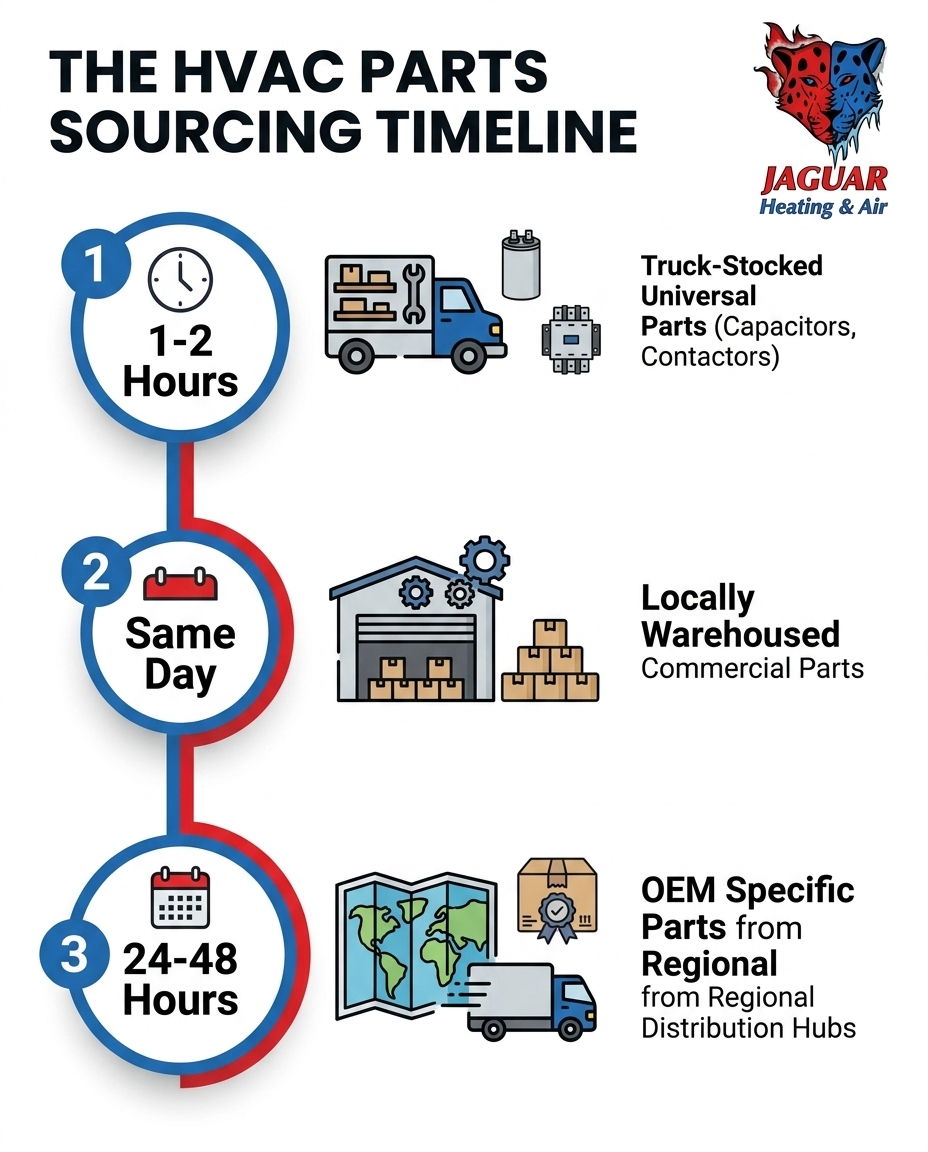
Many common air conditioning failures are caused by universal components that do not require a special order. Parts like dual run capacitors, electrical contactors, standard transformers, and generic blower motors are the unsung heroes of the HVAC industry. Because these items are standardized across dozens of different brands and models, our technicians keep them fully stocked on their service vehicles. This preparation eliminates the need for time-consuming supply house runs.
When a truck-stocked part is the culprit, the repair is typically completed in one to two hours from the moment our technician begins the diagnostic. We recently helped a local homeowner who called late on a Friday night because the blower fan on their house AC would not turn on. Our technician arrived the morning after the call, identified a failed standard component, and had the blower fan repaired within 20 minutes. This kind of rapid turnaround is exactly why standardizing truck inventory is a priority for our team at Jaguar Heating & Air.
Our standard same-day repair sequence:
1. Initial diagnostic: The technician tests the electrical load and identifies the failed universal component.
2. Inventory check: The required capacitor, contactor, or motor is pulled directly from the mobile inventory on our service van.
3. Component replacement: The old part is safely removed, and the new universal part is wired into the system by our certified professional.
4. System verification: The unit is powered back on, and the technician verifies that the cooling cycle is operating at peak efficiency.
This rapid response is critical for restoring comfort before the home reaches dangerous temperatures during August's late-summer peak heat. If your system is exhibiting signs of a standard electrical failure, reaching out for AC repair in Sacramento can often yield a same-day resolution, getting your home back to a comfortable baseline before the afternoon sun peaks.
Navigating OEM Parts and Regional Distribution Centers
Unlike universal parts, Original Equipment Manufacturer (OEM) parts are designed specifically for a single brand or even a specific model year. You cannot swap a proprietary component with a generic alternative without voiding warranties or causing catastrophic system failures. Components like complex control boards, variable-speed compressors, and communicating thermostats are highly specialized. When one of these components fails, the repair timeline shifts from hours to days.
These specific parts must be sourced from authorized supply houses or regional hubs. Because no contractor can carry every proprietary board for every brand on a single truck, our technicians rely on Sacramento area distribution centers to fulfill these orders. Ordering OEM components typically adds 24 to 48 hours to the repair timeline, depending on regional availability and the time of day the failure occurs.
Identifying Proprietary Components
How do our technicians determine if a part is OEM-exclusive? During the diagnostic phase, we cross-reference the system's model and serial numbers with manufacturer databases. Modern, high-efficiency AC systems rely heavily on proprietary technology to achieve their impressive energy ratings. Variable-speed motors and communicating control boards talk to each other using brand-specific digital languages. If a generic part is installed in these advanced systems, the unit simply will not recognize it, making the exact OEM replacement an absolute necessity.
The 24 to 48-Hour Sourcing Window
Once an OEM part is identified, the standard processing time for a local supply house to locate, transfer, and release the component is generally 24 to 48 hours. Our technician submits the order to the commercial distributor, who then pulls the item from a regional warehouse. However, weekend breakdowns can extend this window. If a proprietary board fails on a Saturday afternoon, the order might not be processed until commercial supply houses reopen on Monday morning. Setting realistic expectations around this sourcing window helps reduce frustration while waiting for specific components to arrive.
How Local Supply Chains Impact Wait Times
HVAC supply chain logistics rely heavily on regional hubs rather than direct-to-consumer shipping. You cannot simply log onto a major retail website and order a commercial-grade compressor to your front door. The industry operates on a strict business-to-business model to ensure that only licensed professionals handle high-voltage electrical components and pressurized refrigerants.
Proximity to major Northern California logistics hubs provides a distinct advantage for faster parts transfers. Because the valley is a major thoroughfare for commercial shipping, local contractors benefit from dense warehouse networks. Compared to isolated rural areas where a part might take a week to arrive via freight, local supply houses can often secure components on the same day if they are stored in nearby commercial warehouses. Sacramento area distribution centers act as the central nervous system for regional cooling repairs, funneling necessary equipment to local branches like ours.
The Role of Commercial Supply Houses
Understanding this network explains why our technicians must sometimes leave the property to retrieve specific items. Commercial supply houses are massive, restricted-access warehouses that stock thousands of specialized HVAC parts. Homeowners cannot purchase these specialized parts directly; the supply houses only sell to licensed contractors with established accounts. When our technician diagnoses a failed inducer motor or a specific coil, they contact our supply house representative, reserve the part, and drive to the warehouse to pick it up. This localized infrastructure is what makes same-day and next-day repairs possible in heavily populated areas.
The Ripple Effect of Peak Demand on Inventory
Extreme weather events drive the highest volume of emergency service calls simultaneously across the region. When extreme, triple-digit heat blankets the valley, we see an immediate, simultaneous strain on thousands of local AC units. Systems that have been running perfectly for months suddenly work overtime, exposing hidden weaknesses and causing older components to snap under the pressure.
This sudden spike in demand creates a run on specific components, causing micro-shortages at local supply houses. Even common parts like dual run capacitors can temporarily sell out when hundreds of units fail on the same afternoon. When standard inventory buffers are overwhelmed, technicians are forced to route through secondary distribution channels, which can add hours to the repair timeline. For instance, just last week, a homeowner reached out to us on a tight budget as the back-to-school hot weather was approaching because their AC was blowing ambient air. One of our service techs came out within the hour, explained the system's issues, and fixed the unit before the peak heatwave hit, successfully avoiding the massive inventory rush that followed later that week.
Other seasonal issues we see compounding system stress:
• Dirty air filters: Restricted airflow causes the blower motor to overheat, leading to premature electrical failure.
• Overworked compressors: Running the system continuously without breaks during August's late-summer heat can cause the compressor to trip its internal thermal overload.
• Drainage issues: High demand can lead to AC drain line clogs during high humidity spikes, which trigger safety switches that shut the entire system down.
• Failing insulation: Poorly insulated refrigerant lines force the unit to work harder to absorb heat, accelerating wear on moving parts.
If you find yourself caught in a severe heatwave with a failing system, securing emergency HVAC service quickly is the best way to get your name on the list before local supply houses run dry on critical components.
Leveraging Local Relationships for Faster Turnarounds
Not all contractors have the same access to local supply inventories. The HVAC industry is heavily relationship-based, and established connections with regional wholesale distributors allow for priority sourcing during peak shortages. When micro-shortages hit the Sacramento area distribution centers, supply houses prioritize their highest-volume, most reliable contractors. Working with a well-connected company means your parts order is pushed to the front of the line.
At Jaguar Heating & Air, our strong local supply chain relationships, brand-specific expertise, and rapid emergency response times directly benefit you, the homeowner. Our brand-specific expertise ensures that the correct OEM parts are identified and ordered accurately the first time. There is nothing more frustrating than waiting two days for a proprietary control board, only to discover the wrong version was ordered due to a misread serial number. Our deep local ties and rigorous technical training eliminate these costly errors.
The value of proactive care we provide:
• Catching wear early: Our technicians can spot a bulging capacitor or a pitted contactor weeks before it actually fails.
• Ordering in advance: If a proprietary part is showing signs of decline, we can order it during the spring, completely bypassing the summer rush.
• Protecting the compressor: Keeping coils clean reduces the electrical load on the system, preventing major component failures.
Proactive upkeep can identify worn parts before they fail during a heatwave, bypassing the emergency supply chain altogether. Scheduling routine AC maintenance with our team is the most effective way to secure your comfort and avoid the stress of peak-season logistics.
Restoring Your Comfort Without the Wait
Repair timelines are directly tied to the type of part needed and the strength of the local supply network. Whether you are dealing with a simple capacitor swap that takes an hour or a complex OEM board replacement that takes two days, understanding the logistics behind the scenes helps set clear expectations. You do not have to navigate the stress of a breakdown alone during the late-summer heat.
Working with a well-connected local expert minimizes downtime, even during peak season. A team with deep roots in the community knows exactly which supply houses to call and how to expedite your specific components. Reach out to Jaguar Heating & Air to discuss your system's symptoms and get an accurate, honest assessment of the repair logistics so we can get you back to enjoying a cool, comfortable home.
Frequently Asked Questions
How long does it take to fix an AC unit?
Most standard AC repairs take between one and two hours if the required part is already stocked on our technician's truck. If the repair requires a proprietary component from a local distributor, the timeline can extend to 24 or 48 hours. The total time depends entirely on the specific part that failed and the complexity of accessing it inside the unit.
Why is my AC repair taking so long?
Extended repair times are usually caused by waiting for an Original Equipment Manufacturer (OEM) part to arrive from a regional distribution center. During severe heatwaves, local supply houses can also experience micro-shortages, meaning even standard parts might take an extra day to source. High demand across the entire region slows down the logistics network.
How long does it take to order an HVAC part?
Ordering a standard HVAC part from a local commercial supply house usually takes 24 to 48 hours during the standard business week. If the part is highly specialized or older, it may need to be shipped from a national hub, which can take several days. Weekend breakdowns often delay the ordering process until commercial distributors reopen on Monday.
Can I use my AC while waiting for a part?
We generally recommend leaving your AC turned off while waiting for a replacement part to avoid causing further damage. Running a system with a failing component, like a weak motor or a bad capacitor, can place severe stress on the compressor, leading to a much more extensive failure. Always follow the specific advice of your diagnosing technician.
Why do some AC parts have to be ordered if the technician is already here?
Our technicians carry hundreds of universal parts, but it is impossible to stock every proprietary control board, specific motor, or unique compressor for every brand on the market. Modern high-efficiency systems use specialized digital components that cannot be swapped with generic alternatives. These specific items must be picked up from commercial supply houses.
Does proximity to regional distribution hubs speed up repair times?
Yes, being located near major logistics hubs like those serving Sacramento significantly accelerates the repair process. Contractors in well-connected areas can often drive to a local warehouse and retrieve a specialized part the same day it is ordered. Homes in more isolated regions often have to wait for those same parts to be shipped via freight, adding days to the timeline.
Recent Posts
HVAC Maintenance: Troubleshooting the Fall Heating Startup
Why does your furnace smell like burning on that first chilly morning? Use our home maintenance tips and troubleshooting to know when to call a pro this fall.
HVAC Maintenance: Home Maintenance Tips and Troubleshooting for Fall Heating Startup
Why some systems smell burning during fall startup, and how these home maintenance tips and troubleshooting steps help you decide when to call a professional.
The Fall Seasonal Home Maintenance Checklist: Decoding Heating Startup Smells and Sounds
What that burning dust smell means for your furnace, and how to use this seasonal home maintenance checklist to decide when to call a pro this fall.