.avif)
When to Call for Emergency HVAC Repair and When to Wait
Learn when an HVAC failure is a true emergency in Sacramento: safety hazards, weather risks, mechanical red flags & troubleshooting tips.
Learn when an HVAC failure is a true emergency in Sacramento: safety hazards, weather risks, mechanical red flags & troubleshooting tips.

Is Your HVAC Failure a True Emergency? Here's How to Tell Fast
When an HVAC failure is a true emergency comes down to one straightforward question: does the problem put your health, your home, or your family at risk right now?
Here is a quick reference to help you decide:
| Situation | Emergency? | Action |
|---|---|---|
| Gas smell (rotten eggs) near HVAC unit | Yes — immediate | Evacuate and call 911 |
| Carbon monoxide detector sounding | Yes — immediate | Evacuate and call 911 |
| Burning smell or sparks from unit | Yes — immediate | Shut off power, call HVAC pro |
| No cooling when outdoor temps exceed 90°F | Yes | Call for emergency repair |
| No heat when outdoor temps are below 40°F | Yes | Call for emergency repair |
| Water actively leaking from unit | Likely yes | Shut off system, call HVAC pro |
| Short cycling (rapid on/off) | Likely yes | Call HVAC pro promptly |
| Loud banging or screeching noises | Likely yes | Shut off system, call HVAC pro |
| Mild weather, system underperforming | No | Schedule standard appointment |
| Blank thermostat screen | Not yet | Check batteries first |
| Tripped circuit breaker (first time) | Not yet | Reset once; call if it trips again |
For Sacramento-area homeowners, recognizing the difference between an inconvenience and a genuine emergency can protect your family, your home, and your wallet. Over 60% of HVAC emergencies happen during peak summer or winter — exactly when your system is working its hardest and when the stakes are highest. And while it might feel like every breakdown deserves a midnight call, roughly 40% of reported emergencies turn out to be simple fixes like a dead thermostat battery or a tripped breaker.
This guide walks you through exactly when to call for emergency HVAC repair, when it is safe to wait, and what to do in the meantime.
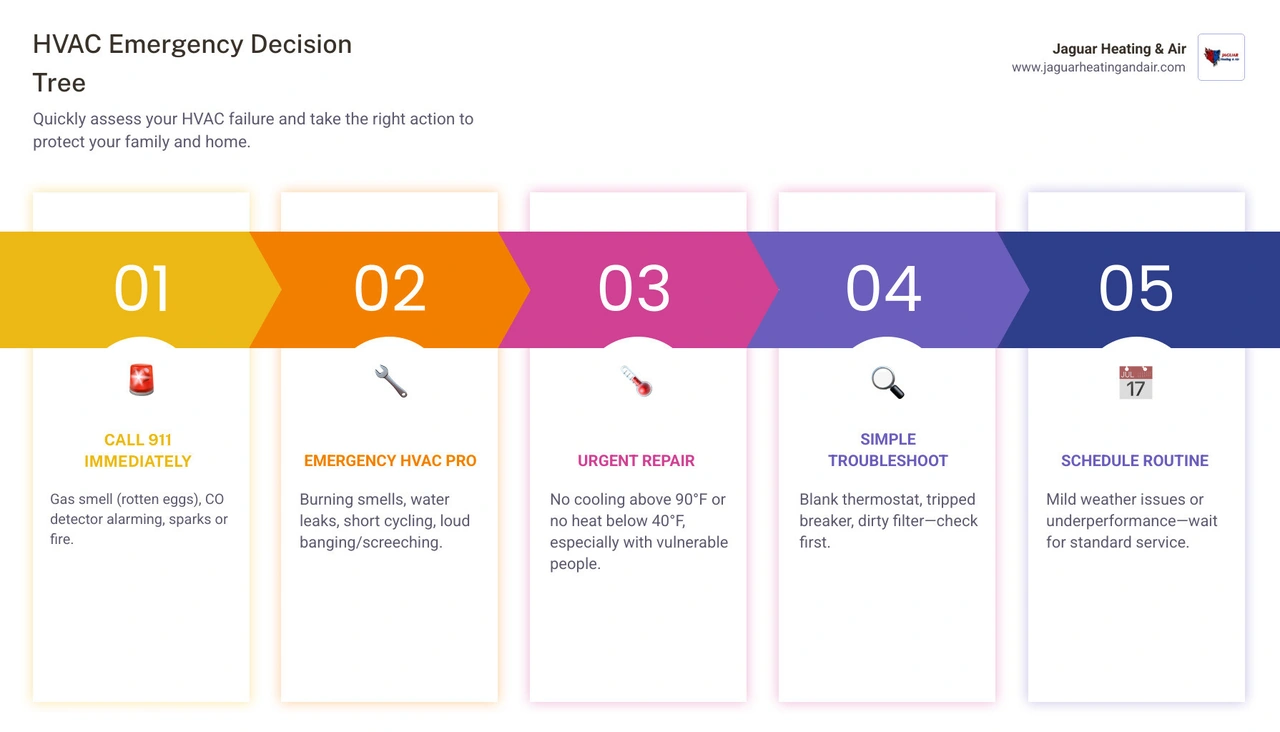
When an HVAC Failure is a True Emergency: Immediate Safety Hazards
In May 2026, home safety technology has advanced, but the fundamental risks of HVAC systems remain the same. The most critical indicators of an emergency are those that threaten your life or the structural integrity of your home. If you encounter any of the following, do not hesitate—safety must always come first.
Gas Leaks and Carbon Monoxide
If you smell "rotten eggs," you are smelling mercaptan, a chemical added to naturally odorless natural gas or propane to help you detect a leak. This is a severe fire and explosion hazard. Similarly, carbon monoxide (CO) is known as the "silent killer" because it is colorless, odorless, and tasteless. Statistics show that unintentional carbon monoxide poisoning sends over 100,000 Americans to emergency departments every year, with faulty HVAC systems being a leading cause.
If your CO detector sounds or you smell gas, evacuate your home immediately. Do not turn light switches on or off, as a single spark can ignite a gas leak. Once you are safely outside, call 911 and then reach out for Emergency HVAC Service Sacramento CA.
Electrical Red Flags
HVAC systems pull more electricity than almost any other appliance in your home. If you see sparks, smell burning plastic, or notice smoke coming from your indoor or outdoor units, you are looking at a potential electrical fire. This is not a situation where you should "wait and see." Shut off the power at your electrical breaker panel immediately.
| Safety Threat | Immediate Action | Professional Needed |
|---|---|---|
| Active Fire/Smoke | Evacuate, Call 911 | Fire Department |
| Rotten Egg Odor | Evacuate, Call 911 | Gas Utility / HVAC Tech |
| CO Alarm Blaring | Evacuate, Call 911 | Emergency HVAC Tech |
| Repeatedly Tripped Breaker | Shut off power | NATE-Certified Technician |
Weather Thresholds and Vulnerable Populations
In the Sacramento Valley, our weather can transition from mild to extreme in a matter of hours. While a broken AC on a 75-degree day in Roseville is a nuisance, a breakdown during a triple-digit heatwave is a health crisis.
The 90-Degree and 40-Degree Rules
We generally use a "40/90 rule" to determine the urgency of a climate control failure:
- The 90-Degree Rule: If outdoor temperatures exceed 90°F, indoor temperatures can reach dangerous levels (sometimes over 100°F) within just a few hours. This makes Fast and Frosty Emergency AC Installation in Roseville CA a necessity rather than a luxury.
- The 40-Degree Rule: If the temperature drops below 40°F, your home's "thermal mass" typically only protects you for 8 to 12 hours. Beyond that window, you risk hypothermia and, eventually, frozen pipes that can burst and cause thousands in water damage. In these cases, you need a Heating Repair Emergency in Sacramento CA.
Recognizing when an hvac failure is a true emergency for vulnerable family members
The threshold for what qualifies as an emergency drops significantly if you have vulnerable residents in your home.
- Infants and Young Children: Their bodies cannot regulate temperature as efficiently as adults, putting them at high risk for heat exhaustion or respiratory distress.
- Elderly Residents: Seniors are more susceptible to heatstroke and hypothermia, especially those with underlying cardiovascular issues.
- Medical Conditions: If someone in your home relies on medical equipment or has a condition aggravated by extreme heat or poor air quality, a failure is an immediate priority. Refer to our Don't Freeze Your Guide to Emergency Heating Installation in Roseville for more on protecting your loved ones during winter outages.
Mechanical Red Flags and Property Risks
Sometimes an emergency isn't about the temperature outside, but about what the machine is doing to your house. Mechanical failures can lead to "wallet-threatening" repairs or structural damage if not addressed instantly.
Water Leaks and Humidity
Your AC and heat pump act as giant dehumidifiers. They produce gallons of water (condensate) every day. If the drain line clogs, that water has nowhere to go but into your drywall, floors, or ceiling. A small drip can turn into a ceiling collapse overnight. Furthermore, if indoor humidity remains above 70%, mold growth can begin in as little as 24 to 48 hours, creating a long-term health hazard. If you see water pooling, shut the system off and call for Affordable Emergency Heat Pump Repair in Roseville CA.
Scary Noises and Smells
Modern HVAC systems should operate with a quiet hum. If you hear loud banging (like a "bag of rocks" in a dryer), screeching, or grinding, a major component like a blower motor or compressor is likely failing. Continuing to run the system could lead to a total motor seizure. Also, watch out for an ether-like smell, which often indicates a refrigerant leak. Since refrigerant is a chemical hazard that requires EPA-certified handling, this is a job for our Rapid Response Sacramento's Top Emergency Heat Pump Repair Services.
Mechanical indicators of when an hvac failure is a true emergency
- Short Cycling: If your system turns on and off every few minutes without completing a cycle, it is placing immense stress on the compressor—the most expensive part of your unit.
- Ice Buildup: Seeing ice on your outdoor copper lines or indoor evaporator coil usually means restricted airflow or a refrigerant leak. If you don't shut it down, you could "slug" the compressor, destroying it.
- Total Airflow Loss: If the fan stops moving air entirely during a freeze or heatwave, the system is dead in the water. For Elk Grove residents, we offer Fast and Reliable Emergency Heat Pump Services for Elk Grove Homeowners to get the air moving again.
Troubleshooting Steps Before You Call for Service
Before you pay for an after-hours service call, perform a "30-second triage." You might find that the solution is something you can handle yourself.
- Check the Thermostat: About 40% of HVAC emergencies actually start with simple thermostat malfunctions. Is the screen blank? Replace the batteries. Is it set to "Heat" when you need "Cool"?
- Inspect the Breaker: Go to your electrical panel. If the HVAC breaker has tripped, flip it all the way off and then back on once. If it trips again immediately, stop. This indicates a short circuit, and continuing to flip it could cause a fire.
- The "Wool Blanket" Filter: A clogged air filter is the leading cause of system overheating and frozen coils. If your filter looks like a thick wool blanket, replace it. We recommend changing filters every 1 to 3 months to prevent 40% of common emergencies.
- Clear the Outdoor Unit: Ensure that tall grass, leaves, or debris aren't choking your outdoor condenser. It needs to "breathe" to transfer heat effectively.
Homeowners who invest in regular maintenance are 50% less likely to experience a total system breakdown. If your system is currently down, check our Sacramento Emergency Heating Installation Guide for steps on what to do next, or read about When Your Heater Quits Elk Grove's Top Emergency Repair Services for localized help.
Frequently Asked Questions about HVAC Emergencies
What qualifies as a true HVAC emergency in Sacramento?
In our region, a true emergency is any situation that poses an immediate threat to safety (gas leaks, electrical sparks), health (extreme heat over 90°F or cold under 40°F for vulnerable people), or property (significant water leaks or risk of frozen pipes). If the weather is mild (between 65°F and 80°F) and everyone in the home is healthy, a breakdown is usually considered a routine repair that can wait for business hours.
When should I call 911 instead of an HVAC technician?
Call 911 if there are active flames, a strong smell of gas (rotten eggs), or if a carbon monoxide detector is sounding and residents are showing symptoms like confusion, dizziness, or vomiting. Always call 911 from outside the home. Once the emergency responders have cleared the site, call a technician to repair the system.
How can I stay comfortable while waiting for emergency repair?
- In Summer: Close all blinds and curtains on the sunny side of the house. Use ceiling fans (set to counter-clockwise), stay on the lowest floor of the home, and stay hydrated.
- In Winter: Gather the family in one central room to preserve body heat. Use portable space heaters safely (keep them 3 feet away from furniture) and never leave them unattended. You can also drip your faucets to prevent pipes from freezing if the heat will be out for more than 24 hours.
Conclusion
At Jaguar Heating & Air, we understand that an HVAC failure is more than just a mechanical problem—it’s a disruption to your family’s safety and comfort. As a family-owned company and Trane Comfort Specialist, we bring local expertise to every call in Sacramento, Elk Grove, Roseville, and beyond. Our NATE-certified technicians are trained to handle the most complex emergencies with flat-rate pricing and a 100% satisfaction guarantee.
Don't let a minor issue turn into a major disaster. Whether you need Emergency HVAC Service West Sacramento CA or routine Heating Repair Services, we are here to provide 24/7 peace of mind. If you're facing a crisis right now, give us a call and let us restore your home's comfort.
Recent Posts
The Fall Seasonal Home Maintenance Checklist: Decoding Heating Startup Smells and Sounds
What that burning dust smell means for your furnace, and how to use this seasonal home maintenance checklist to decide when to call a pro this fall.
Why Does My Heater Smell Like Burning Dust? Common Homeowner Questions Answered & A Fall Guide to AC Repair in Sacramento, CA
Why does your heater smell like burning dust? With common homeowner questions answered, see what we found causes this fall odor and when to call a pro.
Decoding Fall HVAC Startups: Your Guide to Maintenance and AC Repair in Sacramento, CA
Navigating the October Shift: When Sacramento Weather Demands Both Cooling and Heating October in the Central Valley brings a sudden, sharp transition in weathe